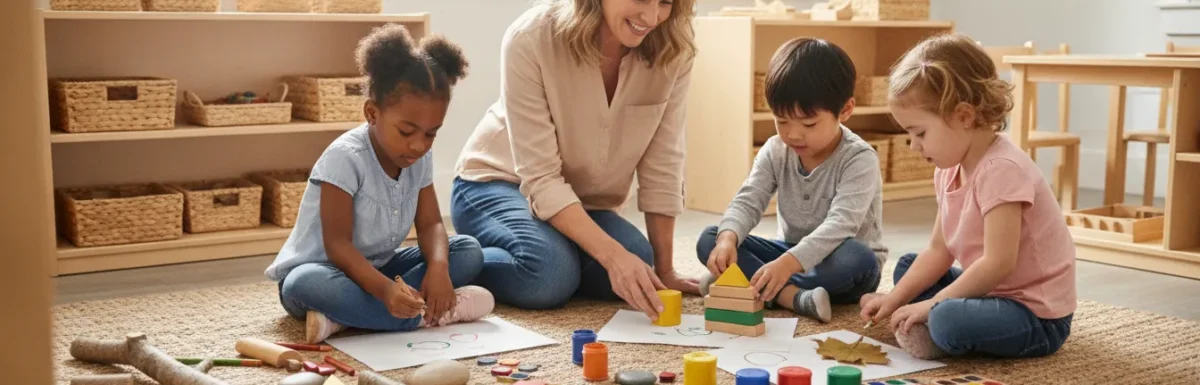
In a preschool or daycare classroom, a strong activity does more than fill a few minutes. It gives children a purposeful way to explore, communicate, move, create, or solve a problem while the teacher observes and responds.
Explore flexible online CDA training for practical early childhood teaching.
Early childhood education activities are intentional, developmentally appropriate learning opportunities built around children’s ages, abilities, interests, and cultural experiences. The best choices have a clear purpose, simple materials, room for exploration, and a teacher who can extend learning with questions or encouragement. They should always be adapted to the group and offered with appropriate supervision and safety practices.
That approach helps educators move beyond choosing an activity because it looks entertaining. It starts with examining what children can practice, how the environment supports participation, and what evidence will show that the experience is meaningful.
What Makes an Early Childhood Education Activity Effective?
An effective classroom activity gives children a meaningful way to explore a skill, idea, relationship, or question. It is not defined by elaborate materials or a complicated teacher script. The strongest activities connect a clear developmental purpose with room for children to make choices, test ideas, communicate, and try again. Play is an important part of children’s learning and development, and intentional teaching helps educators connect play with learning in responsive ways. NAEYC describes intentional connections between play and learning as part of early childhood practice.
Start with a clear purpose and a simple setup
Before presenting materials, identify what you want to notice or support. The purpose might be strengthening hand control, encouraging language, exploring texture, practicing cooperation, or inviting children to solve a problem. Then prepare a manageable setup. For example, place blocks, cardboard tubes, and small baskets in an accessible area and invite children to build a path for a toy. The materials should be familiar enough to use independently while offering more than one possible result.
Use age-appropriate materials and adjust the challenge for each child. A child who is still developing hand strength may need larger pieces, while another child may be ready to combine materials or plan a more complex structure. Match the activity to children’s abilities, interests, cultural contexts, and supervision needs rather than treating one design as appropriate for every group.
Let the teacher guide without taking over
The teacher’s role is to prepare the environment, model safe use, listen closely, and extend thinking. Instead of correcting every choice or demonstrating a single right answer. Describe what you see and offer open-ended prompts: “What could make your bridge stronger?” “What do you notice when you add another block?” or “How might we make space for a friend?” Open-ended questions. Exploration materials, and problem-solving can support physical and intellectual development.
Observe before stepping in. Notice how a child approaches the materials, communicates an idea, persists through difficulty, or responds to another child. A brief note such as “Maya tested three bases before choosing the widest one” gives you useful information about problem-solving and planning. You can use that observation to offer an extension later, such as adding measuring tools or inviting children to draw their structures.
Protect choice, learning, and safety
Offer two or three meaningful choices within the activity, such as building, drawing a plan, or describing what happened. Choice supports engagement without removing the teacher’s purpose. At the same time, inspect materials, keep small or hazardous items away from children who may mouth them, define safe boundaries, and maintain active supervision. Activities belong in a clean, organized environment with predictable routines that help children feel secure.
For help connecting an activity to a broader learning experience, explore these preschool lesson plans. Use the activity as a flexible starting point, then adapt the materials, questions, and level of support based on what children show you.
What Activities Support Physical and Intellectual Development?
Strong classroom activities give children opportunities to move, handle materials, communicate, explore, and make decisions. The purpose is not to make every activity look the same for every child. Match the setup to children’s ages, abilities, interests, cultural contexts, and supervision needs, then observe how each child participates. For a broader developmental reference, review these child development milestones.
Build fine-motor control through purposeful materials
Offer drawing tools, playdough, puzzles, linking materials, tongs, or scissors used with close, age-appropriate supervision. These activities give children ways to grasp, squeeze, turn, cut, and create. The developmental purpose is to practice controlled hand movements while also encouraging choice and persistence. Invite children to draw a story scene, arrange pieces by a feature they notice, or use tongs to transfer items between containers. Instead of correcting the product. Ask. “What are you trying to make?” or “What could you change if that piece does not fit?” Drawing and using scissors are identified examples of fine-motor activities that support physical and intellectual development.
Use movement to connect the body and the mind
Gross-motor experiences can include running, climbing, jumping, balancing, or moving through a simple indoor or outdoor pathway. These activities provide space for children to practice movement while listening, planning, and adjusting their actions. The CDC notes that outdoor play gives children room to jump, run, and climb, and that outdoor games can also support learning and language practice. Ask. “How can you get from here to there?” “What is a safe way to move around this obstacle?” or “Can you show another way?” Keep the environment clear. Supervise actively, and adapt the challenge rather than assuming every child should complete it in the same way.
Invite language, math, sensory exploration, and creativity
Literacy can grow through storytelling with props, picture walks, songs, and conversations about children’s drawings. Prompt children to describe what happened first, predict what may happen next, or explain a character’s choice. For math, provide objects to sort, compare, count, measure, or arrange. Ask, “How do you know these belong together?” or “What do you notice about the two groups?”
Sensory materials such as sand, water, textured objects, or an exploration tray invite children to notice changes, test ideas, and use descriptive language. Art and music extend that exploration through color, rhythm, movement, and creative expression. Offer open-ended materials and ask. “What do you notice?” “What might happen if we try another material?” or “How could we make that sound or design different?” These prompts support the intentional use of exploration materials. Art, music, storytelling, and problem-solving without requiring one correct result.
| Activity focus | Possible setup | Teacher prompt |
|---|---|---|
| Fine motor | Drawing tools, playdough, tongs, or puzzles | What are you trying to make? |
| Movement | Balance path, jumping spaces, or climbing area | What is a safe way to move? |
| Language and literacy | Props, picture books, songs, or story cards | What happened first? |
| Math and science | Objects to sort, compare, count, or measure | How do you know these belong together? |
| Creative exploration | Open-ended art, music, sand, or water materials | What might happen if we try another material? |
Observe the thinking behind the activity
Record brief notes about the child’s actions, language, choices, and strategies. A child who changes a tower after it falls, revises a drawing, or explains a sorting rule is showing useful information about problem-solving and communication. Use that observation to decide whether to add materials, simplify the setup, offer a new question, or provide another opportunity later. Activities should remain adaptable opportunities for learning, planned in a clean, safe environment with appropriate supervision.
How Can Activities Build Social-Emotional Skills?
Social-emotional learning grows through repeated, supported practice in ordinary classroom moments. A feelings activity, cooperative game, or shared cleanup routine gives children opportunities to name what they feel, notice how others may feel, and try respectful ways to respond. The goal is not to expect perfect self-control. It is to provide predictable experiences in which children can practice empathy, sharing, turn-taking, cooperation, and positive guidance.
Use play to make feelings visible
Invite children to choose a picture, puppet, or facial expression that matches a feeling in a familiar classroom scenario. You might say, “The block tower fell. How do you think the builder feels?” Then ask, “What could a friend do to help?” Accept different answers and connect them to observable actions. Such as offering a block, asking before touching, or sitting nearby. Avoid labeling a child as good or bad. Describe the feeling and the behavior instead: “You look frustrated because you were still using the truck. Let’s find a way for both children to have a turn.”
Practice cooperation with simple games
Set up a partner activity that requires two children to complete one task. Such as carrying a lightweight basket together, building a road from large blocks, or passing instruments around a circle. Model language before the activity begins: “Can I have a turn when you are finished?” “You may use it after me.” “Let’s decide together.” Provide a visual turn-taking cue when helpful. But keep the focus on communication rather than speed. During play, notice specific efforts: “You waited while Maya placed her piece,” or “You both changed the plan so everyone could help.”
Teach calming as a routine
When children are calm, practice slow breathing with a simple image, such as smelling a flower and gently blowing a pinwheel. Add a short pause to transitions, circle time, or a cozy reading area. If a child becomes overwhelmed, offer a quiet choice and stay close: “Your body needs a break. You can breathe with me or sit in the calm space.” Calming practice should support connection and safety, not serve as isolation or punishment.
Predictable routines and an organized classroom can help children feel safe while they learn and play. Plan these activities with appropriate supervision, and adapt materials, language, and expectations to each child’s age, ability, interest, and cultural context. For more guidance on positive preschool behavior strategies, connect each response to the behavior’s purpose and the relationship you are building with the child.
Build practical classroom knowledge through flexible online CDA training.
How Do You Adapt Activities for Age, Ability, and Interest?
Developmentally appropriate activities should match the child, not require every child to complete the same task in the same way. Before introducing an activity, consider what children can already do, what they are curious about, and what support will help them participate safely. Then use a simple cycle: observe, adjust, and extend.
Start with observation
Watch how children approach the materials, communicate, move, and solve problems. A preschooler who quickly sorts objects by color may be ready for a more complex matching or counting challenge. Another child may be more engaged by collecting, building, or telling a story than by sitting for a worksheet. These observations help you choose a meaningful entry point instead of assuming that age alone determines readiness.
For example, offer a basket of natural objects, blocks, or classroom materials and invite children to sort, compare, arrange, or describe them. Younger children might explore texture and size. Older or more experienced children might create patterns, explain their choices, or invent a shared classification system. Keep the purpose clear, but allow more than one successful response.
Adjust access without lowering expectations
Adapt the materials, the amount of time, the directions, or the way children respond. Provide larger tools, thicker crayons, stable seating, or a smaller number of materials when a child needs more physical access. Demonstrate one step at a time, use picture cues, or offer a partner when language or attention support would help. A child who is not ready to use scissors might tear paper, place stickers, or make marks with a crayon while still practicing fine-motor control and creative choice.
Offer choices within the same activity. Children might draw, build, move, dictate their ideas, or explain them verbally. These options respect different abilities while keeping children connected to a shared classroom experience. Follow individual support plans and supervision requirements, and never treat an adaptation as a replacement for appropriate assistance.
Extend interests and honor culture
Children’s interests can guide the next question. If a child is fascinated by buses, invite the group to design routes, count wheels, compare sizes, or act out a trip. If children are exploring family traditions, include songs, stories, languages, foods, and materials represented accurately and respectfully. Ask families what names, practices, and experiences are meaningful to their children rather than relying on assumptions or token displays.
After the activity, ask what changed and what could come next. Did a child persist longer, communicate a new idea, or invite a peer into play? Use that observation to adjust the next experience or extend the challenge. This is different from writing a full lesson plan. For a broader bridge from adaptable activities to intentional classroom planning, explore these preschool lesson plans.
How Can Teachers Use Outdoor Play Safely?
Outdoor play can turn a familiar early childhood education activity into an opportunity for movement, observation, language, and problem-solving. A simple nature walk might invite children to notice textures, compare leaves, or describe what they hear. An open space can support jumping, running, balancing, and climbing while children practice taking turns and judging their own abilities. The CDC notes that outdoor play gives children room to move and explore, but it also requires thoughtful attention to illness and injury risks.
Begin with active supervision rather than watching from one location. Position yourself so you can see the whole play area, scan continuously, and stay close to children who need additional support. Before children go outside, check the surface, equipment, boundaries, and materials. Choose sturdy, age-appropriate items such as large natural objects, soft balls, buckets, or child-safe digging tools. Remove sharp, broken, unstable, or small objects that could create a hazard. Children can explore and test limits, but teachers should set clear boundaries and adjust the environment when a risk exceeds the child’s developmental readiness.
Plan for weather and comfort
Weather should shape the timing, location, length, and intensity of outdoor activities. On hot or sunny days, provide access to shade and encourage protective clothing, including wide-brimmed hats and clothing that covers arms and legs. Children often depend on adults to help them stay cool and hydrated. So make water available and offer regular opportunities to drink rather than waiting for children to ask. Watch for signs that a child is becoming overheated, tired, uncomfortable, or unwell, and follow the program’s health and weather procedures.
Cold, wet, or windy conditions also call for preparation. Encourage families to provide suitable layers and footwear when outdoor play is appropriate. Keep a dry, shaded, or indoor alternative ready when conditions make participation unsafe or uncomfortable. These decisions should follow the program’s policies and applicable local requirements, not a one-size-fits-all rule.
Make safety part of the learning
Use brief, positive reminders before and during play. Say. “Show me where your feet will land,” “How can we carry this safely?” or “What do you notice about this branch?” Teachers can model active play when they can do so safely. They can also help children solve problems without taking over. The CDC identifies outdoor games as opportunities to practice learning, language, and emotional skills. Afterward, record a short observation, such as how a child navigated a balance path, cooperated with peers, or used new descriptive words. That note can guide the next outdoor invitation.
For additional guidance, review the CDC resources on outdoor play and safety for children in early care and education and physical activity in early care programs. These are evidence-informed resources, not a substitute for supervision, individualized support, or the requirements that apply to a specific program.
How Do Activities Connect to CDA Competency Goals?
A purposeful classroom activity can support more than one developmental outcome at a time. It can also give you evidence of how your teaching reflects the six CDA competency goals: safe and healthy environments. Physical and intellectual development, social and emotional development, partnerships with families, program management, and professional commitment. Use the goals as a planning lens, not as a reason to turn every play experience into a worksheet.
Map the activity to the goal it serves
Start with safety and health. Before a sensory bin, movement game, or art invitation, check that the space is clean, materials are appropriate, and supervision is adequate. Predictable routines, such as handwashing before snack or a consistent transition to outdoor play, help children feel secure while reinforcing healthy habits.
Physical and intellectual development can be visible in a simple obstacle path, drawing invitation, story retelling, or building challenge. Running and climbing support large-motor practice, while drawing and using scissors develop fine-motor control. Add an open-ended prompt such as, “What could you try next?” to invite problem-solving, language, and reasoning. The activity should be adjusted for each child’s age, ability, interest, and cultural context.
Social and emotional development appears when children share materials, take turns, recognize feelings, cooperate, and use positive guidance during a group experience. Family partnerships can grow when you share a child’s interest or emerging skill with families and invite information about related routines, languages, or experiences at home. This keeps planning responsive rather than isolated from the child’s wider life.
Program management is reflected in thoughtful preparation, accessible materials, clear transitions, and a classroom arrangement that supports independent participation. Professional commitment means observing your own decisions, seeking better ways to respond, and connecting daily practice to reliable training. You can learn more about CDA competency goals and how they relate to classroom work.
Use routines and observations as evidence
Do not limit documentation to center time. Circle time, cleanup, handwashing, and snacks can all reveal development and teaching impact. Write a brief, objective note: “During cleanup. Maya sorted the cars by color and asked Leo for a turn after a reminder.” Then connect it to a goal and decide what to offer next.
For reflection, ask: What did the child do, what did I do, and what small change could make the next experience safer, more inclusive, or more engaging? Scenario-based learning can strengthen this kind of decision-making by using realistic classroom situations and asking educators to choose a practical response.
Frequently Asked Questions
What are 5 developmentally appropriate activities?
Try a sorting activity with natural objects or classroom materials, a story retelling with props. Drawing or cutting with close supervision, a simple movement course, and an open-ended building challenge. Match each activity to the children’s ages, abilities, interests, and supervision needs. Ask what they notice, predict, or would change so the activity becomes an opportunity for language, problem-solving, creativity, or physical development.
What are some fun activities I can do with preschool children?
Preschoolers can enjoy a sound-and-movement game, a pretend-play setup, a collaborative mural, a nature scavenger hunt, or a water-and-measuring exploration. Keep the goal flexible and let children make choices within a safe setup. Your role is to model language, support cooperation, and observe how each child participates rather than directing every step.
What are some fun educational activities for kids?
Educational activities can include matching games, storytelling, music and rhythm, sensory exploration, dramatic play, and group problem-solving. A strong activity connects a clear developmental purpose with hands-on materials and teacher prompts. For example, ask children to compare amounts during a sorting game or explain how they built a structure. Play is an important part of children’s learning and development, according to the National Association for the Education of Young Children: https://www.naeyc.org/resources/topics/play.
What are 5 examples of activities?
Five adaptable examples are a picture-book retelling, a shape or color sort, a painting invitation, a balance-and-movement course, and a partner game that practices taking turns. Prepare materials in a clean, organized area and provide appropriate supervision. Afterward, record a brief observation about what a child tried, communicated, or needed, then use that information to extend the next activity.