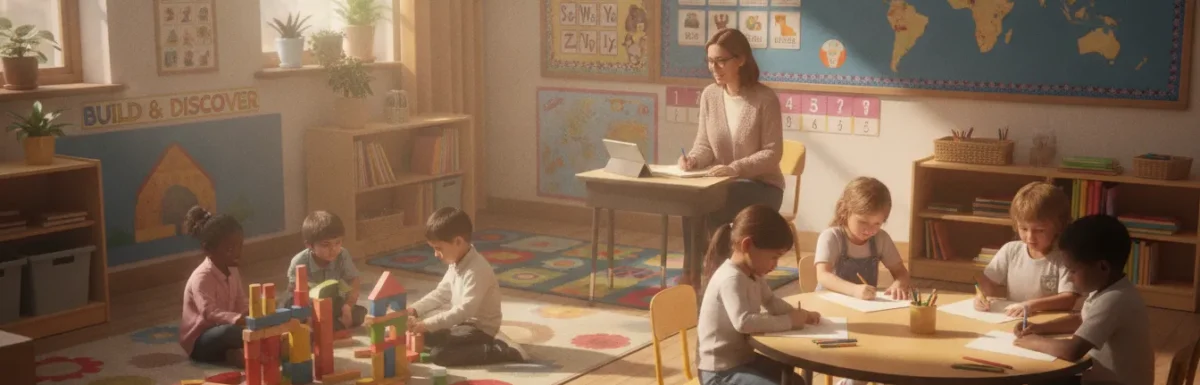
Preschool teachers must manage active children who learn and grow at widely different rates. Tracking this development is simple when you use a structured, objective framework.
Ready to grow your career? Enroll in our online CDA training today or call (269) 444-6128.
Child development milestones are the specific, observable skills that preschool children typically achieve in how they play, learn, speak, act, and move by certain ages. According to the Centers for Disease Control and Prevention (CDC), these standards provide a sound, proven framework to track daily classroom progress. Preschool teachers use these objective tools to find potential learning delays early and connect their observations directly to professional CDA credential training programs. This detailed observation practice helps educators plan targeted, play-based activities that support cognitive, language, social, and physical growth in every student. Mastering these skills builds the intuitive grasp needed to manage a diverse early childhood classroom and meet national competency standards with absolute confidence.
How can early childhood teachers track these stages while managing a busy preschool classroom? This guide answers that key question by breaking down each developmental domain to help you, starting with the Physical Development Milestones for Ages 3-5. The path begins with.
Child Development Milestones: Physical Development Milestones for Ages 3-5
Active play and physical movement are key to how young children learn. Physical growth is not just about getting taller. It involves learning gross and fine motor skills that build the base for learning. Under CDC tips, tracking these child development milestones helps teachers support healthy growth. Every child develops at their own pace, but these markers show general trends.
Gross Motor Skills: Building Large Muscle Strength
Gross motor skills use the large muscles of the body for running, jumping, and balance. By age three, most children can walk up steps using one foot on each step. They can also throw a ball. As they reach four and five, they learn to hop on one foot, skip down hallways, and climb slides and swings. They also learn to catch a large ball with both hands. These milestones show that a child is building body control and muscle strength. Teachers can use active games to help children practice these movements in the classroom. For example, setup an indoor obstacle course to encourage safe climbing and hopping. This type of play helps children feel sure in their physical skills. Group games like tag or follow the leader also build teamwork.
Fine Motor Skills: Refining Small Hand Movements
Fine motor skills focus on the small muscles in the hands and fingers. During this stage, children learn to use child-safe scissors to cut paper and draw clear circles and squares. They also start to do daily tasks with less help from adults. According to the CDC guidelines, preschoolers should be able to help dress and undress themselves, recall part of a story, and sing songs. Dressing tasks include buttoning clothes and pulling up zippers. They also work on brushing teeth without help. Developing these small hand muscles is a key step that helps them hold a pencil and learn how to write. You can offer bins of dry rice or beans to help build hand strength. Tearing paper and building with blocks also refine hand movements.
Classroom Observation: Tracking Physical Growth
Preschool teachers must watch children during daily tasks to track physical growth. You can observe motor skills during outdoor play or center time. To help students meet these goals, teachers can design developmentally appropriate learning activities. These activities target specific muscles and help children reach key milestones. For instance, clay play and bead stringing build fine motor strength. On the playground, you can watch how kids climb or catch a ball. Tracking these physical gains aligns with CDA Subject Area 2, which focuses on Advancing Physical and Intellectual Development. Using what you see helps teachers plan lessons for every child. You can note which kids need more help and adjust your daily plans.
Cognitive Development Milestones in the Preschool Classroom
A cognitive milestone is a thinking or problem-solving skill a child gains by a certain age. Preschoolers build these mental skills through play, constant questions, and guided tasks. Tracking these preschool developmental milestones helps teachers support every child’s growth and design good daily lessons.
Core thinking skills for preschool children
Between ages three and five, children have rapid brain growth. They learn to sort shapes and name basic colors. Many can count ten or more objects.
They also begin to grasp basic time concepts like yesterday, today, and tomorrow. At this stage, children can follow two or three-step directions without getting lost. They ask why and how questions all day long to make sense of their world.
Based on data from the Centers for Disease Control and Prevention, children at this stage can recall parts of a story and sing simple songs. These skills show that their memory and thinking skills are growing strong.
The role of play in mental growth
Pretend play is a key tool for building these mental skills. Preschoolers love to act out complex stories. They may pretend to be doctors, shop at a grocery store, or live out fairy tales.
This type of play helps them solve problems and think in new ways. Using play based learning in your classroom supports this cognitive growth.
This work directly aligns with CDA Subject Area 2, which aims to boost physical and intellectual skills in young learners. Helping children create their own play themes supports deep thinking. It also helps them practice social rules with their friends.
What to watch for during center time
To track growth, teachers must watch children during free play and group tasks. Note how they handle toys and work with peers during center time. Look at how they solve puzzles or react when a tower of blocks falls. Recording these notes is a key part of observing child development milestones in a preschool.
These daily checks help you find children who may need extra help. They also let you celebrate the small wins of every student in your care. By knowing what to look for, you can make sure each child gets the support they need to learn and grow.
Social-Emotional Development: What Preschool Teachers Should Watch For
In this stage, child development milestones show key shifts in how kids interact. Children ages three to five build social independence and bond with peers. Teachers must watch how they share, express feelings, and play with others. Tracking these skills helps educators support growth and meet early childhood goals.
Growing independence and exploration
As children grow into early childhood, their world opens up. They love to explore and ask questions about things around them. According to the CDC, preschoolers also become much more independent. During this time, they begin to focus on adults and peers outside their immediate family.
This change helps children learn to separate from parents or caregivers with less fear. In the classroom, a child might choose a task on their own or clean up without being asked. These small steps show they can act on their own. Teachers should give children safe choices throughout the day to build this key life skill.
Peer relationships and social play
Play is a main tool for social development. Playing with other children helps preschoolers learn the value of sharing and friendship. These peer groups teach kids how to take turns, follow rules, and read group dynamics. Over time, they start to control their own feelings and show empathy to those around them.
By playing in groups, children learn how to solve small fights on their own. They start to see that other people have different thoughts and needs. Group games also teach them how to handle wins and losses with grace. These shared play times are critical for building long-term social skills.
Classroom observation and management
Teachers can track this progress with simple classroom observation methods. Writing short notes during free play is a great way to log peer skills. These methods must align with developmentally appropriate practice to guide child growth. Setting up positive classroom management strategies can support these social goals.
This observation work links directly to CDA Subject Area 3, which focuses on supporting social and emotional development. By watching children interact, teachers can find those who need extra support. Designing a structured room with clear routines helps kids feel secure. This safe space allows them to practice new social skills with ease every day.
Here are three practical techniques teachers can use:
- Use running records to track peer interactions during free choice time.
- Write brief notes when children share or show care.
- Fill out checklist forms based on positive classroom management strategies.
Language and Communication Milestones for Ages 3-5
Language milestones for ages three to five show a rapid rise in speaking skills. During this stage, children grow from using short phrases to telling long stories with over two thousand words. Tracking these verbal skills helps teachers monitor broader child development milestones to support classroom learning and find areas that need extra help.
Vocabulary growth from ages three to five
During the preschool years, children have a big rise in the words they know and use. A typical three-year-old knows three hundred to one thousand words. These young learners speak in short, simple sentences to share their thoughts.
By age four, most children use one thousand to two thousand words. They speak in longer sentences of four to five words and ask many questions. By age five, a child knows over two thousand words. They can now tell detailed stories and talk about their day with ease. They can also use complex words and share their feelings.
Sentence structure and emerging literacy skills
As vocabulary grows, children build better grammar skills. They learn to follow multi-step directions, such as cleaning up toys and sitting on the rug. They also gain early reading skills. These include holding a book the right way, finding some letters, and hearing rhyming words. This growth connects directly to CDA Subject Area 2, which focuses on intellectual development.
Teachers can use play based learning in your classroom to support these verbal skills. Role-play areas let kids act out stories and talk with friends. For example, a play store setup lets children practice asking questions and sharing goods. This simple practice helps them learn how to take turns in a conversation.
Language development red flags and concerns
While every child develops at their own pace, some signs may point to a delay. Tracking language skills is a vital part of monitoring child development milestones as outlined by the CDC. Teachers should look for certain red flags that show a child may need extra support. At the same time, they must remember that typical changes are normal, as kids grow at their own speed.
- Not using three-word sentences by age three
- Trouble following simple, two-step directions by age four
- Unclear speech that family members cannot understand by age four
- Not being able to tell a simple story by age five
Early childhood teachers are often the first to notice speech delays. Finding these issues early allows the classroom team and parents to seek expert screening tools. Addressing these concerns quickly helps kids gain the skills they need for school success.
How to Observe and Document Developmental Milestones in Your Classroom
Classroom observation is more than just watching children play. To support early growth, teachers must learn how to track and record key developmental progress. By learning how to monitor child development milestones, you can find the best ways to guide each student. Effective tracking helps you see where a child stands and when they need extra support. It also lets you spot any delays early so that you can help quickly.
Practical observation methods
In your preschool classroom, you can use five key methods to track developmental milestones. These tools help you build a clear picture of each child’s growth. They also give you the proof you need to share progress with parents during meetings:
| Method | Best For | Time Needed | Portfolio Use |
|---|---|---|---|
| Anecdotal records | Capturing specific behaviors and social interactions in real time | 1-2 minutes per observation | Strong evidence for competency statements |
| Developmental checklists | Tracking milestones across physical, cognitive, and language domains | Quick scan during daily routines | Shows systematic assessment approach |
| Work samples and portfolios | Documenting fine motor and cognitive progress over time | 5 minutes to collect and date samples weekly | Required part of CDA Professional Portfolio |
| Photo documentation | Capturing social skills, physical play, and creative expression | 30 seconds per photo | Visual proof of child growth and teaching practice |
| Review and compile | Finding patterns and planning next steps for each child | 15-30 minutes weekly | Shows reflective teaching practice |
CDA competency standards alignment
Your classroom observation notes do not just sit in a file. They directly feed into your CDA professional portfolio. You will use these records to write your competency statements and show your skills. These notes are the foundation of your professional growth.
Your notes on child development milestones support your work in CDA Subject Area 7. This subject area focuses on observing and recording children’s behavior. Learning how to observe is critical for every early childhood teacher. Using child development milestones in your classroom observation techniques helps you better support child growth.
Our training helps you connect these pieces. The National CDA Training curriculum is aligned with the eight CDA competency standards to support your success. When you learn how to track milestones, you are also preparing for your credential. You will have a much easier time documenting learning activities in your CDA portfolio. You can use your daily observations to write strong notes. Read our guide to the CDA competency standards explained to see how the process fits together.
Scenario-based classroom practice
Learning to observe child development milestones takes practice. You cannot build these skills just by reading a textbook. You need to see how observation works in real life. The scenario-based training method at National CDA Training is designed to help you build intuitive, practical responses to real-world classroom scenes.
This method allows for mental practice through virtual classroom scenes to help you move beyond rote learning. You will watch virtual scenarios and practice taking notes. By working through realistic scenarios, you learn what to look for and how to write clear notes. You will gain the skills you need to run a successful, observant classroom.
Frequently Asked Questions
Why do preschool teachers need to track child development milestones?
Tracking milestones helps teachers plan daily lessons and find developmental delays early. But teachers must know that basic checklists are not official medical tools. According to the CDC, standard milestone resources are meant to help teachers, not replace proven developmental screening tools.
What should a teacher do if a child misses developmental milestones?
If a child does not meet typical milestones, a teacher should write down what they see using classroom notes. Share these notes with the family and ask them to talk with their doctor. Teachers should never try to diagnose a child. Instead, use resources from the CDC to help parents get professional help.
How do child development milestones connect to CDA competency standards?
Knowing child milestones is key to meeting several Child Development Associate (CDA) standards, especially those for body, mind, and social growth. Official CDA competency standards require teachers to use milestone tracking in daily lessons and classroom observations. Our online CDA courses help you learn how to connect these milestones to your daily routine.
How do preschool teachers support social development in the classroom?
Teachers can support social growth by planning play times with peers. According to the CDC, playing with other children helps children learn the value of sharing and friendship. Group games and shared tasks help kids manage their feelings and build strong bonds with other adults and children outside their family.
Ready to Deepen Your Understanding of Child Development?
Without a clear way to track milestones in your classroom, you risk missing key growth stages and failing to support children who need help. Delaying your professional education only holds back your teaching career and makes it harder to meet your state licensing requirements on time each year. Setting up your child development milestones training today ensures you can use these new skills in your classroom right away to help children thrive.
Ready to build your classroom skills? Call (269) 444-6128 today to schedule a free consultation to learn how CDA training deepens your understanding of child development. You will gain the confidence to lead your classroom and help every child succeed.