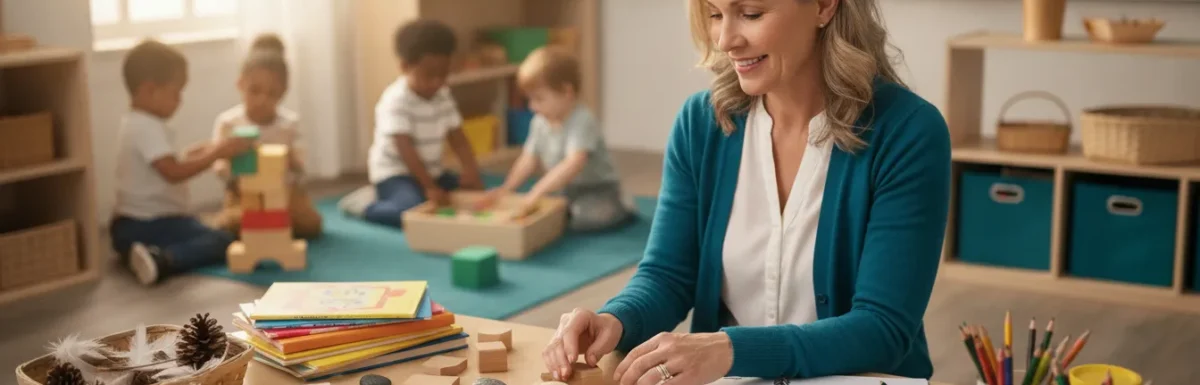
Strong preschool lesson plans do more than fill a calendar. They help educators turn children’s questions, interests, and everyday discoveries into purposeful learning experiences. The best plans give teachers a clear goal and a thoughtful starting point while leaving enough room to follow children’s ideas and respond to what they show you.
Explore individual CDA training for practical early childhood teaching skills.
Preschool lesson plans are written guides that connect a learning goal to an age-appropriate experience, materials, teacher support, and a way to observe children’s learning. An effective plan is intentional but flexible. It may include play, conversation, movement, art, stories, or problem-solving, and it can be adjusted for children’s interests, abilities, languages, and developmental needs. The goal is not to make every child complete the same product. The goal is to create meaningful opportunities for children to explore, practice, communicate, and grow.
Why are preschool lesson plans important?
Preschool lesson plans help teachers make learning intentional without making the classroom rigid. A written plan gives the teaching team a shared direction, helps organize materials, and makes it easier to notice whether an experience supported the intended goal. It also creates a starting point for reflection: What engaged the children? Which questions led to deeper thinking? Who needed another entry point?
The National Association for the Education of Young Children explains that developmentally appropriate curriculum should reflect what educators know about young children in general and about each child in particular. That means a plan should connect to development, culture, language, interests, and prior experiences rather than treating an age group as if every child learns in exactly the same way.
Planning also protects balance. Across a week, children need opportunities for language and literacy, early math, science, creative expression, physical development, and social-emotional learning. These areas do not have to be separated into isolated lessons. A story about planting seeds can lead to counting, vocabulary, observation, drawing, cooperation, and outdoor exploration.
What should a preschool lesson plan include?
A useful lesson plan answers a few practical questions before children enter the experience. What do you want children to explore or practice? What will they do? What will you provide? How will you support different learners? What evidence will show you where to go next?
| Planning element | Question for the teacher | Example |
|---|---|---|
| Learning goal | What skill, concept, or disposition will children explore? | Children will compare and describe objects by size. |
| Experience | What will children actively do? | Sort natural objects, then explain a chosen sorting rule. |
| Materials | What is safe, accessible, and open-ended? | Large pinecones, smooth stones, baskets, and picture cards. |
| Teacher support | What prompts or modeling may extend thinking? | “What do you notice? How could we sort these another way?” |
| Observation | What will you watch, listen for, or document? | Children use comparison words and explain their decisions. |
| Adaptation | How can every child participate meaningfully? | Offer tongs, visual choices, partner talk, or a quieter work area. |
Keep the plan focused. One clear goal with a well-designed experience is often more useful than a long list of disconnected objectives. If the plan tries to cover too much, it becomes difficult to observe what children actually understand.
How do you create preschool lesson plans step by step?
Building a plan becomes easier when you use the same thinking sequence each time. The format can be a formal template, a planning board, or a short written note, as long as it captures the decision-making that guides your teaching.
1. Start with observation and children’s interests
Before choosing an activity, look closely at what children are already doing. Are they comparing sticks on the playground? Trying to write names? Negotiating roles in dramatic play? Asking repeated questions about animals, weather, or how things work?
Observation keeps planning connected to real children rather than to a generic theme. Record exact words, actions, questions, and strategies when possible. A child who repeatedly builds a tall block structure may be showing interest in balance, measurement, collaboration, or storytelling. Those observations can lead to different plans depending on the learning goal you select.
2. Choose one or two observable learning goals
Use language that describes what children may do, say, make, or demonstrate. “Understand science” is too broad to guide one experience. “Children will predict which objects will sink or float and explain what happened” gives you something concrete to plan for and observe.
Choose goals that are meaningful for the group and appropriate for the children in front of you. You may connect the goal to your program’s curriculum framework or early learning guidelines, but do not let a standard replace professional judgment. The standard names a destination. Your observations help you decide the next step.
3. Design an active, hands-on experience
Preschool children learn through doing, talking, moving, pretending, testing, and revising ideas. Design an experience in which children have something real to investigate. They might build a bridge for toy animals, mix colors, create a map of the classroom, act out a story, or work together to solve a practical problem.
Play-based learning is one strong way to make a plan engaging. The existing National CDA Training guide to play-based learning in preschool explains how teachers can prepare materials, observe play, and use questions to extend children’s thinking. In a lesson plan, the teacher’s role is not to control every move. It is to create a safe environment, introduce a purposeful invitation, and provide support when children need it.
4. Prepare the environment and materials
Put materials where children can reach them and understand how to use them safely. Use real objects and open-ended items when possible, because they can support more than one solution. Before the experience, check the size, condition, and sensory qualities of every item. Consider choking hazards, allergies, mobility needs, and whether children can participate without waiting for an adult to do every step.
Think about the arrangement as part of the lesson. A small table may support focused sorting. An open floor area may support large-motor movement. A cozy space may help a child who needs a lower-stimulation way to participate. The environment can either invite investigation or create unnecessary barriers.
5. Plan prompts, modeling, and vocabulary
Prepare a few prompts that encourage children to explain their thinking instead of guessing the answer you want. Useful prompts include:
- What do you notice?
- What do you think will happen?
- How could we test that idea?
- What is another way to solve the problem?
- Can you show or tell a friend what you discovered?
Choose a small set of words to use naturally during the experience. For a building activity, those words might include balance, taller, wider, support, and collapse. For a story retelling, they might include beginning, problem, character, and solution. Model the words in conversation, then give children time to use them in their own ways.
6. Plan flexible supports before the lesson begins
Adaptation is easier when it is part of the plan rather than a reaction after a child has already become frustrated. Offer different ways to enter the experience. A child may point, gesture, use home language, dictate an idea, draw, move, or speak. Some children may need a visual sequence, a peer partner, larger tools, additional processing time, or a shorter first turn.
Do not lower the learning goal simply because children need different supports. Change the path, materials, group size, amount of language, or level of adult assistance. For example, children can explore the same concept of comparison with objects of different sizes, a picture sort, or a movement game.
7. Observe, document, and reflect
During the experience, watch for evidence connected to your goal. Write down a short quote, take a sample of children’s work when appropriate, or make a quick note about the strategy a child used. Avoid trying to record everything. Focus on evidence that helps you decide what to repeat, extend, or change.
Afterward, ask yourself three questions: What did children do that showed progress? Where did the experience lose their interest or create frustration? What is the next useful challenge? The answer may be a follow-up lesson, a new material in a learning center, a small-group invitation, or simply more time to practice.
Find more CDA resources for connecting early childhood teaching ideas to daily practice.
How can you make a preschool lesson age-appropriate?
Age-appropriate planning is not about making every activity easy or giving every child the same worksheet. It means matching the experience to children’s current development while offering a reasonable stretch. Preschoolers need active participation, manageable steps, opportunities to make choices, and repeated chances to use new skills in meaningful settings.
The Head Start teaching and learning environment requirements describe the value of responsive teaching, organized learning environments, child-initiated and teacher-directed activities, and active and quiet experiences. That balance is useful for any preschool classroom. A plan can begin with a short teacher invitation, move into child-led exploration, and end with a brief conversation or transition.
Use these questions to check a plan before teaching it:
- Can children participate with their current motor, language, and attention abilities?
- Does the experience offer more than one way to respond or solve a problem?
- Are the materials familiar enough to feel approachable but interesting enough to invite discovery?
- Does the plan respect children’s cultures, family experiences, languages, and identities?
- Can I adjust the challenge if children are ready for more or need a different starting point?
- Does the experience include a safe choice for a child who does not want to join immediately?
When you are observing development, remember that milestones describe skills children typically develop, not a scorecard for judging a child. The CDC developmental milestones resources can help families and educators notice skills and identify questions to discuss with a child’s healthcare provider. Classroom observations should remain objective and should not be used to diagnose a developmental condition.
What are examples of engaging preschool lesson plans?
Examples are most useful when they show the planning logic rather than prescribe one activity for every classroom. The same topic can support different goals depending on what children are currently exploring.
| Child interest | Possible learning goal | Learning experience | Evidence to observe |
|---|---|---|---|
| Puddles after rain | Make predictions and notice change. | Test which objects move, float, or sink in shallow water. | Children describe a prediction and compare the result. |
| Restaurant dramatic play | Use language, symbols, and cooperation. | Create menus, take orders, count pretend items, and switch roles. | Children communicate a plan, use marks with meaning, or negotiate roles. |
| Repeated tower building | Explore balance, measurement, and problem-solving. | Build with blocks, test a design, and sketch or describe what changed. | Children revise a structure and explain why it worked or fell. |
| Interest in feelings | Identify emotions and practice problem-solving. | Use puppets to act out a peer problem and generate possible solutions. | Children name a feeling, listen to another view, or suggest a safe response. |
| Questions about seeds | Observe living things over time. | Plant seeds, draw changes, and compare what plants need. | Children use observation language and connect changes to care. |
These experiences can be brief or extended depending on your schedule and the children’s engagement. A plan does not have to end when the formal activity ends. Children may continue the learning during block play, writing, outdoor time, art, or conversation with families.
Use National CDA Training’s CDA resources to keep building practical classroom knowledge.
How can teachers keep lesson plans flexible?
Flexibility starts with separating the learning goal from the exact activity. If your goal is for children to compare quantities, the experience might be a snack setup, a game with counters, a block challenge, or a dramatic-play store. If the planned activity is not working, protect the goal and change the route.
Build in choices and a stopping point. Invite children to choose materials, partners, roles, or a question to investigate. Watch for signs that the group needs movement, a smaller group, more modeling, or a transition. A plan that can change in response to children’s participation is more useful than one that must be completed exactly as written.
It is also helpful to plan a simple extension and a simpler entry point. If children master the first challenge quickly, add a new condition, ask them to explain their strategy, or invite them to help a peer. If the challenge is too difficult, reduce the number of materials, model one step, or return to a familiar example. This keeps the experience purposeful without turning it into a test.
Frequently asked questions about preschool lesson plans
What is the purpose of a preschool lesson plan?
The purpose is to connect an intentional learning goal with a meaningful experience, appropriate materials, teacher support, and observation. A lesson plan helps educators prepare and reflect while leaving room to respond to children’s interests and needs.
How long should a preschool lesson plan be?
There is no single ideal length. Write enough to make the goal, materials, prompts, adaptations, and observation focus clear to the teaching team. The experience itself should match children’s attention, energy, and the program’s daily rhythm rather than an arbitrary time limit.
Should preschool lesson plans be play-based?
Play is a valuable context for preschool learning because children can explore, make choices, communicate, and solve problems through active experiences. A strong plan may include child-led play, guided play, teacher modeling, stories, movement, or small-group conversation. The key is to connect the experience to a meaningful goal without taking away children’s agency.
How do I adapt a lesson plan for different learners?
Keep the central goal and adjust the route. Offer visual supports, partner work, home-language connections, different tools, varied group sizes, movement options, more processing time, or a quieter participation space. Observe what helps each child engage, then document the support that made the experience more accessible.
How do I know whether a preschool lesson plan worked?
Look for evidence connected to the goal, such as a child’s words, actions, questions, strategies, or work sample. Also consider engagement and access. A plan may need revision if children could not enter the activity, the materials created barriers, or the goal was not visible in what children did.
Final takeaway
Engaging preschool lesson plans begin with children, not worksheets. Observe what they are noticing, choose a focused and observable goal, design an active experience, prepare flexible supports, and use what you learn to plan the next step. With that cycle, planning becomes a practical tool for responsive teaching and meaningful early learning.
National CDA Training connects early childhood educators with online professional development designed to support real classroom practice. Visit the individual CDA training page to learn more about available training pathways and explore the CDA resources collection for additional guidance.