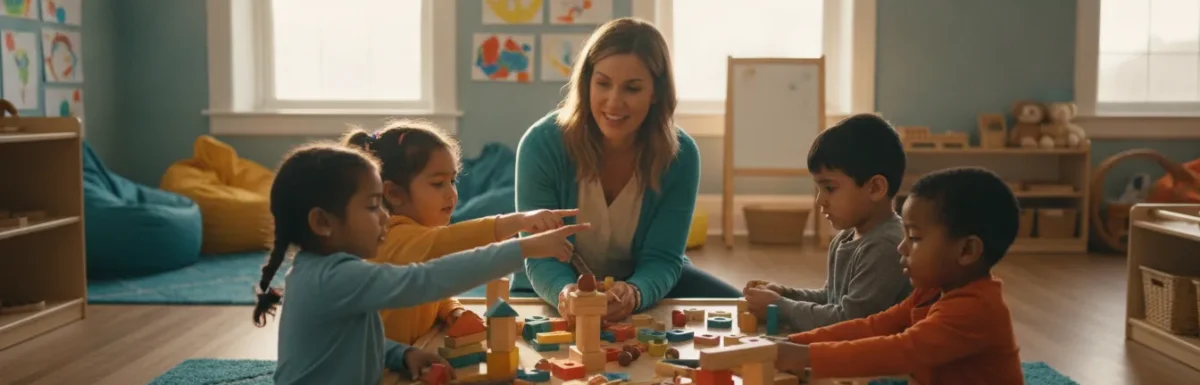
Every classroom reflects a set of beliefs, whether those beliefs are written down or simply expressed through daily choices. The way you arrange materials, respond to children, invite play, document learning, and partner with families all communicate what you believe young children need to thrive.
Explore flexible online CDA training for early childhood educators.
An early childhood education philosophy is a guiding framework of beliefs and values that shapes how educators nurture, care for, and teach young children. It does not prescribe one identical classroom model. Instead, it helps teachers make consistent, thoughtful decisions about relationships, learning environments, play, observation, planning, and professional growth.
Understanding that framework makes it easier to move from abstract ideas to intentional practice. Start by examining what a philosophy guides in the classroom, then consider how major approaches translate those beliefs into everyday experiences for children.
What does an early childhood education philosophy guide?
An early childhood education philosophy is a guiding perspective about how young children learn, develop, relate to others, and experience the world. It helps educators make consistent decisions rather than treating each classroom choice as an isolated task. A philosophy may shape the questions a teacher asks, such as: What does this child need to feel secure? How can the environment invite exploration? When should I step in, and when should I give the child more time?
A philosophy is not the same as a curriculum package, teaching technique, or named method. Montessori, Reggio Emilia, Waldorf, and HighScope are associated with distinct traditions and practices, while play-based learning and developmentally appropriate practice describe broader ways of organizing learning. Programs may draw from more than one approach. The important issue is whether the choices fit the children, families, setting, and program goals, not whether the classroom carries a particular label.
The environment and relationships
Philosophy can influence how a classroom is arranged and what children are able to do independently. An educator might provide accessible materials, quiet spaces, open-ended resources, or areas that support collaboration and pretend play. The environment communicates expectations: children may be encouraged to make choices, care for materials, solve problems with peers, or return to an unfinished idea.
It also shapes relationships. A teacher who views children as capable learners may listen carefully, invite their ideas, and use guidance instead of relying on control. Strong relationships remain central, regardless of the selected approach. Children need responsive adults, predictable routines, and respectful interactions while they build social-emotional skills.
Play, observation, planning, and reflection
Purposeful play is a significant part of many early childhood programs. A philosophy helps teachers decide how to balance child-initiated exploration with intentional invitations, small-group experiences, and direct support. Observation then provides evidence for the next decision. A teacher may notice a child’s sustained interest in building, record the strategies used, and plan additional materials or questions that extend the learning.
Developmentally appropriate practice is best understood as a decision-making framework informed by child development, each individual child, and the child’s social and cultural context. NAEYC outlines these considerations in its core considerations for developmentally appropriate practice. It does not require one universal classroom style.
Reflection completes the process. Educators consider what children experienced, whose perspectives were included, what barriers appeared, and what they might adjust next time. This connection between beliefs and daily decisions makes an early childhood education philosophy practical: it guides safe environments, meaningful learning, family relationships, and professional growth. Educators can connect that reflection to their CDA competency goals.
Which major early childhood education philosophies shape classroom practice?
An early childhood education philosophy is more than a label on a program brochure. It influences what teachers notice, how they arrange the room, how children participate, and how learning experiences are planned. The approaches below have distinct emphases, but many programs thoughtfully combine elements rather than following one model in a rigid way.
| Approach. | Environment. | Play and planning. |
|---|---|---|
| Play-based or emergent curriculum | Offers accessible materials, flexible spaces, and warm relationships that support children’s interests and choices. | Teachers use purposeful play, observation, and children’s questions to shape next experiences. Schedules may include both structured and unstructured periods. |
| Montessori | Uses an orderly, enriched environment with hands-on materials designed to encourage concentration and growing independence. | Teachers observe closely, introduce materials, and allow children to practice skills with increasing self-direction. Maria Montessori developed practices through careful observation of children and their learning needs. |
| Reggio Emilia | Views the environment as an important teacher and emphasizes collaboration among children, educators, and families. | Children’s ideas can lead to long-term inquiry projects. Teachers listen, observe, document, and use children’s comments and questions to plan materials and follow-up questions. |
| Waldorf | Often emphasizes rhythm, imagination, natural or simple materials, and developmentally paced experiences. | Teachers may protect time for creative play, storytelling, movement, and imitation. Programs should explain how their interpretation of Rudolf Steiner’s ideas informs planning. |
| HighScope | Centers children’s active participation, with adults providing support, materials, and consistent opportunities to make choices. | The plan-do-review sequence can help children anticipate an activity, engage in it, and reflect on what happened. Teachers use these interactions to guide future planning. |
| Developmentally appropriate practice | Creates a caring learning community by considering child development, each child’s individuality, and social and cultural context. | Teachers make intentional decisions about play, instruction, observation, and assessment. They do not apply one activity identically to every child. NAEYC identifies these three considerations as central to DAP. |
These distinctions are useful when evaluating classroom choices, not when ranking teachers or children. A play-based classroom may use intentional small-group instruction. A Montessori-inspired room still depends on responsive relationships. A Reggio-inspired project still requires careful preparation, and a DAP framework can guide decisions within many different curricula. The central question is whether the approach helps educators create safe, engaging experiences that respect children’s development and identities.
For example, a teacher who notices sustained interest in building might offer varied construction materials, record children’s language and collaboration, and plan questions that extend their thinking. The exact response may look different in a Montessori, Reggio-inspired, HighScope, or emergent classroom. But observation remains the bridge between children’s current activity and the teacher’s next intentional decision.
Programs can also communicate their philosophy more clearly by connecting it to visible practices: how families participate. How the environment is arranged, how conflicts are guided, what documentation is shared, and how plans change after observation. That connection gives educators a practical standard for reflection instead of treating philosophy as an abstract statement.
How do philosophies influence play, observation, and planning?
An educational philosophy becomes visible in the choices teachers make throughout the day. It can shape whether children have extended time for self-directed exploration, how materials are introduced, what adults record, and how the next learning experience is planned. These choices do not look identical in every program, even when educators use the same philosophical language.
Play can be structured, open-ended, or both
In a play-centered classroom, teachers may provide purposeful materials and a clear learning intention without controlling every step. For example, an educator might place ramps, balls, blocks, and clipboards in the discovery area. Children can test movement and balance in their own ways while the teacher listens for questions, introduces vocabulary, or invites children to compare what they notice. Purposeful play is described as a significant part of early childhood programs. And preschool schedules may combine structured and unstructured periods so children can work at their own pace. Learn more about play-based learning in preschool for additional classroom examples.
Another philosophy may emphasize carefully prepared materials, extended concentration, group projects, or active exploration in a rich environment. A teacher might offer a hands-on sorting material and allow a child to repeat the activity independently. In a different classroom, children may work in a small group to investigate a question that emerged during block play. Neither example automatically represents a complete philosophy. The important point is that the educator’s view of children and learning influences how much choice, guidance, collaboration, and repetition the environment makes possible.
Observation turns children’s actions into planning information
Observation is more than recording whether an activity was completed. A teacher may note that several children negotiated roles during dramatic play. That one child returned repeatedly to a challenging puzzle, or that children used detailed language while constructing a bridge. Documentation can include brief notes, children’s work samples, photographs taken according to program policy, or children’s own explanations. The purpose is to understand interests, strategies, relationships, and support needs rather than to label a child from one moment.
Some inquiry-oriented approaches specifically describe teachers as listening, observing, documenting, and analyzing children’s comments and questions. That information can guide the preparation of materials, questions, and follow-up experiences. For example, after observing sustained interest in animal habitats, a teacher might add nonfiction picture books. Natural materials, maps, and opportunities for children to represent their ideas through drawing or construction. This is responsive planning, not simply filling a calendar.
Planning responds to children while preserving intention
Responsive planning does not mean abandoning learning goals or allowing the day to become entirely unstructured. Teachers can connect children’s interests to language, math, social-emotional, creative, and physical development. A planned experience might begin with a teacher invitation, then change as children reveal new questions. Strong preschool lesson planning leaves room for that adjustment. The philosophy is reflected in the questions the teacher asks afterward: What did children show us? What support or materials might deepen the investigation? Which children need another entry point?
Across approaches, the goal is thoughtful alignment between beliefs and practice. Teachers observe carefully, plan intentionally, and remain willing to revise when children’s responses provide better information.
How can educators choose or blend an approach?
Choosing an early childhood education philosophy is less about selecting a label and more about making consistent decisions for children, families, and educators. A program can draw from more than one tradition, but the blend should be understandable in daily practice. Teachers should be able to explain why they arrange the room, plan experiences, guide behavior, and communicate with families in particular ways.
Start with the view of the child
Ask what the program believes about how young children learn and participate. Are children viewed as active investigators, capable decision-makers, developing members of a community, or learners who need carefully sequenced support? The answer should influence the balance of teacher direction, child choice, play, conversation, and hands-on exploration. Purposeful play can remain an important part of the day while teachers provide structure, introduce materials, and support individual developmental needs.
Consider families, culture, and community
A philosophy should respect the children and families actually present, not just reflect a program’s preferred terminology. Consider which languages, traditions, caregiving expectations, and community experiences should be visible in the environment and curriculum. Ask how families will contribute ideas, share knowledge, and receive information about their children’s learning. A program that values partnership needs practical routines for listening and responding, not only a statement on its website.
Match the approach to the setting and resources
Review the environment, schedule, staffing, materials, group size, and program requirements. An approach that depends on extended project work may need protected time for revisiting questions. One that emphasizes independence may require accessible materials and carefully taught routines. A play-centered schedule may include both structured and unstructured periods, allowing children to explore at their own pace. The strongest plan is one the team can implement reliably and adapt when conditions change.
Test the blend through observation
Write a short set of decision prompts for staff: Does this experience support the child’s current developmental needs? Does it include children with different abilities, interests, and ways of communicating? Is the environment safe, inviting, and culturally responsive? What did observation show, and what should change next? These questions connect philosophy to planning rather than treating it as an abstract statement.
Finally, identify nonnegotiable program requirements and explain where adaptation is appropriate. Labels do not guarantee identical practice. Two programs may both use the same philosophy while differing in schedules, materials, teacher roles, family partnerships, and inclusion practices. Clear shared principles, regular team reflection, and evidence from children’s experiences make a thoughtful blend more coherent than a list of names.
How does philosophy support professional reflection?
An early childhood education philosophy becomes most useful when it helps an educator examine real choices, not simply describe an ideal classroom. Reflection asks whether the environment, interactions, activities, and routines communicate the values a program claims to hold. It also keeps the focus on children’s development, individuality, safety, and relationships with families.
For example, an educator who values child agency might review a learning center and ask: Do children have meaningful choices? Is the schedule flexible enough for sustained exploration? Did my guidance support independence, or did I step in too quickly? An educator who emphasizes family partnership might examine whether classroom communication respects families’ knowledge, culture, and goals. These questions turn broad beliefs into observable professional decisions.
Use documentation to examine decisions
Documentation gives reflection something concrete to examine. Brief observation notes, children’s words, work samples, photographs, and planning records can reveal patterns that are easy to miss during a busy day. A teacher might notice that the same children consistently lead group play. That a child participates more fully with different materials, or that a planned activity did not match the group’s interests.
In a Reggio-inspired professional development example, teachers listen, observe, document, and analyze children’s comments and questions before preparing materials, curriculum, and questions. The Cycle of Inquiry similarly connects analysis of documentation with intentional planning for longer-term inquiry. These practices do not require an educator to copy one named approach. They offer a disciplined way to pause, interpret what happened, and decide what to try next.
Test philosophy in realistic scenarios
Reflection is also valuable before and after challenging situations. Consider a child who refuses to join a group activity, a conflict over materials, or a family concern about classroom routines. An educator can ask which response best reflects the program’s stated commitments while meeting the child’s immediate needs. Would the response protect dignity, encourage communication, and preserve a sense of belonging?
Scenario-based learning supports this kind of mental practice by presenting realistic classroom situations and asking learners to make decisions similar to those they may face in practice. Connecting these decisions to the CDA competency goals can help educators consider safe environments, child development, social-emotional support, family relationships, program operation, and professional commitment together rather than as isolated topics.
Make reflection part of continuing growth
A useful reflection ends with a next step: revise the environment, gather another observation, invite family input, discuss the situation with a colleague, or pursue additional learning. Recording that process in a professional reflection portfolio can make growth visible over time. The goal is not to prove that every decision was perfect. It is to develop the honesty, attention, and professional judgment needed to keep improving practice for children and families.
Explore online CDA training to strengthen your early childhood teaching practice.
What should a personal teaching philosophy include?
A personal teaching philosophy is a clear statement of the beliefs that shape your decisions with children, families, and colleagues. It does not need to sound academic or fit a formal rubric. It should help you explain what you believe children need, how you understand your role, and how those beliefs appear in daily practice. Use the following structure as a starting point, then make it specific to the children and community you serve.
- Your view of the child. Describe how you see children as learners and people. You might emphasize their curiosity, strengths, individuality, developing independence, or right to feel safe and respected. Explain how this view affects the expectations and choices you make.
- Your role as an educator. State whether you see yourself primarily as a guide, responsive partner, observer, facilitator, advocate, or some combination of these roles. Include how you provide support while allowing children meaningful opportunities to make choices and solve problems.
- The learning environment. Explain what a safe, welcoming, and engaging classroom should offer. Consider accessible materials, predictable routines, space for movement and quiet, and an arrangement that encourages children to explore, communicate, and participate.
- Relationships and family partnership. Describe how you will build trust with children and collaborate with families. A strong philosophy recognizes families as important sources of knowledge about their children and makes room for different cultures, languages, values, and experiences.
- Play and learning. Explain what you believe children learn through play, conversation, hands-on exploration, and other experiences. Purposeful play can be a significant part of an early childhood program, alongside intentional activities and opportunities to learn at each child’s pace.
- Observation and planning. Show how you will notice children’s interests, questions, interactions, and progress, then use that information to plan responsive experiences. Observation should lead to thoughtful decisions, not simply record keeping. Connect your plans to developmentally appropriate goals and the individual children in your care.
- Inclusion and professional growth. State your commitment to belonging, equitable participation, and adapting support for different abilities and needs. End by explaining how you will seek feedback, reflect on challenges, learn from families and colleagues, and continue developing your practice.
Your statement is a working document, not a permanent label. Revisit it after meaningful classroom experiences, new learning, or changes in your group of children. If your practice develops, your philosophy should be revised to reflect what you are learning and how you are putting those beliefs into action.
Frequently Asked Questions
What is an early childhood education philosophy?
An early childhood education philosophy is a guiding set of beliefs about how young children learn, how adults should support them, and what makes a learning environment meaningful. It influences daily choices such as classroom arrangement, relationships, play opportunities, observation, planning, and reflection. A philosophy is not a script, so educators may adapt practices to individual children, families, culture, and program requirements.
What are the five theories of early childhood education?
There is no single official list of five. Commonly discussed approaches include play-based or emergent learning, Montessori, Reggio Emilia, Waldorf, and HighScope. Developmentally appropriate practice is also widely used as a decision-making framework. These approaches differ in emphasis, but each can prompt thoughtful decisions about children’s independence, interests, relationships, materials, routines, and participation.
How do different philosophies affect classroom practice?
They can affect how teachers organize the environment, introduce materials, respond to children’s interests, and document learning. For example, Montessori commonly emphasizes hands-on materials and growing independence. While Reggio Emilia is associated with project work, creative expression, family partnership, and the environment as an important teacher. HighScope is commonly described through active participatory learning and plan-do-review. Actual classrooms may blend practices rather than follow one approach in a pure form.
How can teachers choose or blend an early childhood education philosophy?
Start by identifying the view of the child and the educator’s role that best supports your learners. Then consider children’s developmental needs, family perspectives, cultural context, staffing, space, materials, program goals, and applicable requirements. Observe what children do, document their interests and progress, and reflect on whether classroom decisions support safe, responsive, inclusive learning. A thoughtful blend is appropriate when it remains coherent and serves children well.
Ready to build your early childhood teaching practice?
Understanding an early childhood education philosophy can help you connect classroom decisions with children’s development, relationships, and learning. National CDA Training’s online program offers a practical next step for educators who want to strengthen their knowledge and confidence for classroom work. Explore online CDA training to get started.