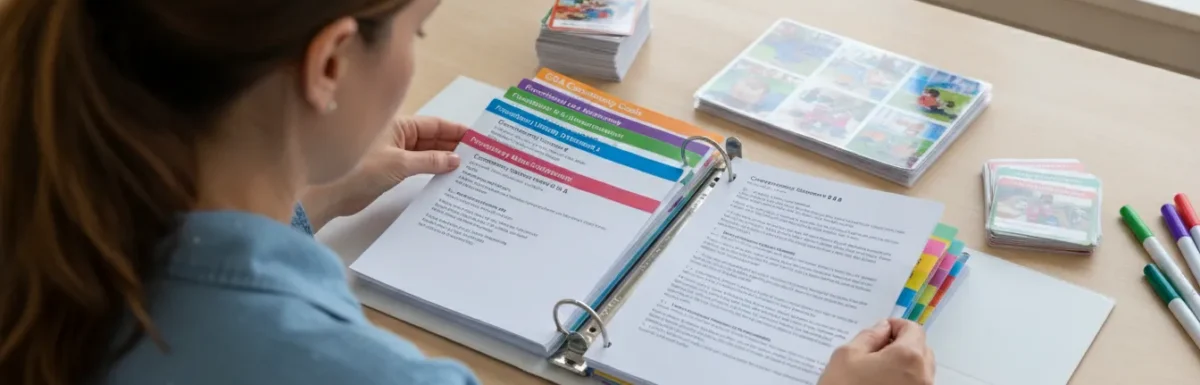
A messy three-ring binder can stop a qualified early childhood educator from earning their CDA credential. You must prove your skills through a strictly organized set of documents. This guide shows you how to build a binder that passes review with ease.
Enroll in our scenario-based CDA training and get the Digital Portfolio Assistant.
The CDA Professional Portfolio is a required, structured collection of files that proves your skills across six CDA standards. You must organize your binder with nine labeled sections from A to I. It contains your philosophy statement and six reflective writing pieces. It also holds a collection of practical classroom items. This binder is the main proof of your professional growth. The Council for Professional Recognition says your binder must include specific cover sheets and family forms. You also need records of 120 hours of formal education. By following a section-by-section checklist, you can ensure every piece is present. This approach helps you focus on showing your expertise. This organized system makes the review easier for your specialist.
Understanding the layout of this binder is the first step toward your credential. Many teachers feel overwhelmed by the long list of requirements. To build your binder correctly, you must first answer the question: What Is the CDA Professional Portfolio? The process begins with these essentials.
What Is the CDA Professional Portfolio?
Enroll in our CDA training today to get expert portfolio guides and one-on-one coaching.
The CDA Professional Portfolio is a set of files that proves you have the skills to work with young children. It uses a three-ring binder with nine labeled parts, from A to I. This binder shows the Council for Professional Recognition that you meet all 6 CDA Competency Standards and 13 Functional Areas.
The binder layout
The CDA Professional Portfolio keeps your work in nine clear areas. You must label these parts well to help your Professional Development (PD) Specialist check your work. Use a clear CDA Portfolio Requirements Checklist to make sure you do not miss any forms or items.
Many teachers feel stress when they start their binder. But the portfolio is just a place to store what you know. You will add items like your first aid card, class plans, and notes from parents. These parts show your growth and your work in child care.
Core goals and rules
The main goal of the binder is to show how you teach. Each part links to the rules set by the Council. You will write six short pieces that tell how you keep kids safe and help them learn. These notes are the heart of your binder because they show your own style.
Your portfolio also has a Professional Philosophy Statement. This is a short essay where you share how you think kids grow. When you finish, the binder is a full record of your work goals and skills. It is the last step before you earn your CDA.
Section A: What Cover Sheets Do You Need?
Section A starts your CDA Professional Portfolio with three key parts. You must include your Professional Portfolio Cover Sheet, a Summary of Education, and your Family Questionnaire data. These pages set the stage for your binder and prove you have met the basic rules for the Council for Professional Recognition.
Enroll in our Guided Track to use our Digital CDA Portfolio Assistant and expert tools.
What items go in Section A?
This section holds the basic records of your career and training. You will need your My Professional Portfolio Cover Sheet as the first page. Behind that, place your Summary of Education Cover Sheet along with your high school diploma or GED. You should also add any papers that show you finished your 120 hours of formal training.
The final part of Section A is the Family Questionnaire Cover Sheet. This page lists the results of the feedback you got from the parents of children in your care. Using a helpful tool like the CDA Portfolio Workbook can help you keep these forms in the right order for your review.
How do you collect Family Questionnaires?
You must collect at least three finished forms from families to pass your review. The Council for Professional Recognition suggests giving out more than three to ensure you get enough back on time. These forms allow parents to share their views on how you care for their children and support their growth.
To get these back fast, tell parents why their feedback matters for your credential. You might send a short note home or talk to them during drop-off. Keep a log of who got a form so you can check in if needed. Once you have three or more, tally the results on your summary sheet and place them in your binder.
Why are these sheets needed?
These cover sheets help your reviewer find your info fast. They act as a map for the rest of your work. Without them, your binder may look messy or not full. Taking the time to fill them out right shows you are a true pro in the early child care field.
How Do You Write Your Professional Philosophy Statement?
Your professional philosophy statement sits in Section B of your CDA Professional Portfolio. This one-to-two-page document outlines your core beliefs about how young children learn. It serves as a personal guide for your work and sets the tone for your entire binder. A strong statement shows that you understand best practices and value each child as an individual.
Enroll in our Guided Track to use the Digital CDA Portfolio Assistant today.
What Reviewers Look for in Section B
Reviewers want to hear your authentic voice as an educator. They look for a clear link to child-centered values. Your statement should explain your role in supporting growth. It is helpful to show how you create a safe space where every child can thrive. This shows that you understand the needs of the children in your care.
A good philosophy statement often includes clear goals for your classroom. For example, you might write: “I believe that every child has the right to feel valued. Respected, and empowered within their learning environment.” This type of reflection shows a deep commitment to the healthy development of children according to federal rules. It also links your daily tasks to your big goals for the students.
Connecting Beliefs to Reflective Practice
This section is the first step in your reflective practice for the credential. While the later parts focus on specific skills, Section B is about your big-picture vision. It explains the “why” behind the way you teach. Writing this document helps you prepare for the rest of your work. It helps you find your professional path as a teacher.
You should keep your language professional but simple. Focus on how you help families and work with other staff. If you need help with your thoughts, our CDA Portfolio Examples Guide offers more tips for each section. Remember that this statement is a living document that may change as you gain more experience.
What Goes in Reflective Competency Statements (Sections C-H)?
The core of your CDA Professional Portfolio consists of six Reflective Competency Statements. These writing pieces, labeled as Sections C through H, show how you meet the national standards set by the Council for Professional Recognition. You must write one statement for each of the six CDA Competency Standards to prove your skills as an educator.
To succeed, you need to use real classroom examples from your daily work. Each statement should explain your goals and the methods you use to support children’s growth. You can learn more about how to structure these by checking out our CDA portfolio examples guide for clear templates and ideas.
Writing for Each Competency Standard
Every statement must address the specific goals of that standard. For instance, CS I focuses on how you keep children safe and healthy while providing a good place to learn. CS II looks at how you support physical and intellectual growth through play and instruction. Each piece of writing helps the reviewer see that you know how to apply your training in a real setting.
You should also link your writing to the 13 Functional Areas. These areas cover tasks like safety, health, and social skills. When you write CS III, you might describe how you help kids handle their feelings or build new friendships. Using clear, direct language makes it easier for the council to see that you meet every need of the children in your care.
A Step-by-Step Guide to the Six Statements
Follow these steps to complete Sections C through H in your binder:
- Draft Competency Statement I (Section C): Focus on safety and health. Describe your routines for cleaning toys or checking the playground to keep kids out of harm’s way.
- Draft Competency Standard II (Section D): Detail how you help kids learn. Give examples of science or math activities that build their minds and small motor skills.
- Draft Competency Standard III (Section E): Write about social and emotional growth. Explain how you help children work together and feel good about their own progress.
- Draft Competency Standard IV (Section F): Discuss family ties. Describe how you talk with parents and make them feel like part of the school team.
- Draft Competency Standard V (Section G): Focus on program management. Show how you plan your day and keep records to ensure the classroom runs with a clear purpose.
- Draft Competency Standard VI (Section H): Describe your professional commitment. Mention how you keep learning new skills and follow legal rules like those from the Department of Health and Human Services.
By following this sequence, you ensure that your portfolio meets all requirements for the CDA credential. Each section builds a full picture of your life as a teacher. Using a tool like our Digital CDA Portfolio Assistant can help you organize these thoughts and finish your binder with less stress.
What Resource Collection Items Belong in Your Portfolio?
Your Resource Collection serves as a set of tools you will use in your classroom. This part of your CDA Professional Portfolio has five items, known as RC I through RC V. You must find or make these things to show you have the tools to help young kids. Use a clear CDA Resource Collection checklist to track each item as you add it to your binder.
| Item | Description | What to Include |
|---|---|---|
| RC I | First Aid and CPR card | Current certification from a recognized provider like the American Red Cross |
| RC II | 9 learning experiences | Lesson plans covering science, math, literacy, fine motor, gross motor, and creative arts |
| RC III | Weekly menu | Healthy meal and snack plan that meets nutritional guidelines |
| RC IV | Weekly plan | Schedule showing balance of play, rest, and instructional time |
| RC V | Bibliography | At least 10 children’s books with summaries and learning goals |
Required Health and Safety Records
The first item you need is your current First Aid and CPR card. This proof must come from a group that meets top rules, such as the American Red Cross. Keep your card valid through the date you send your form. This paper shows you are ready to keep kids safe during a crisis in your care center.
You also need to include a weekly menu for the kids you teach. This menu should show that you give healthy meals and snacks that meet basic needs. If you work in a place that gives food, you can use the main menu from your site. This part of the book proves you know how to plan for a healthy place to learn.
Learning Activities and Planning Tools
You must write out 9 CDA learning experiences for your binder. These are lesson plans that cover areas like math, science, and arts. Each plan must show how you help a child grow in mind and body. You should list the goals, tools, and steps for each task to show your teaching skills in work.
Your book also needs a weekly plan that shows how you set up a full week of care. This plan should include time for play, rest, and school tasks. It helps show that you can run a class schedule well. Make sure your plan fits the age group you work with to meet the CDA rules.
Books and Resource Lists
The last item in this part is a list of kids’ books. You need to list at least ten books that you can use in your class. For each book, you should write a short summary of the story. Also, tell how it helps kids learn. Pick books that show different ways of life to show you value all kids in your teaching.
Making this set takes time but makes sure you are ready for your review. By getting these items now, you make a useful tool set that you can use for a long time. Each piece brings you one step closer to finishing your CDA Professional Portfolio and getting your badge.
How Can the Digital CDA Portfolio Assistant Streamline the Process?
Enroll in our Guided or VIP track today to access the Digital CDA Portfolio Assistant.
The Digital CDA Portfolio Assistant is an AI tool that helps you build your binder. It comes with our Guided and VIP tracks to make your work easier. This tool guides you through every part of the CDA Professional Portfolio. You can use it to organize your cover sheets and collect resources fast. It saves you time so you can focus on your students.
What makes our tool different?
We use a unique scenario-based training method to teach you. This way, you learn by doing real tasks you face in class. Our tool helps you apply what you learn to your portfolio statements. You will not just read about rules. You will show how you use them to help children grow. This approach follows the goals set by the Council for Professional Recognition.
How does it help you save time?
Building a full binder can feel like a big job. The assistant breaks it down into small steps you can finish. It helps you pick the right items for your resource collection. You can also get help with your CDA portfolio building course work. The tool makes sure you have every document you need before you apply for your credential. With this help, you can finish your portfolio with less stress.
Can you get expert help?
Yes, the Guided Track gives you more than just an AI tool. You also get two coaching sessions with Mary Wardlaw, Ed.S. She has over 20 years of experience in early childhood work. She knows exactly what the U.S. Department of Health and Human Services looks for in high-quality care. Her expert advice helps you feel ready for your final review. You get the best of new tech and real human wisdom.
Frequently Asked Questions
How much does it cost to apply for a CDA credential?
As stated by the CDA Council, the fee to apply for a new CDA credential is $425. This cost pays for your review and the final visit. If you want to renew a current credential, the fee is $149. You must pay this amount when you send your files to the Council. It is best to save for this cost while you work on your binder.
How long does it take to build a CDA Professional Portfolio?
Most teachers spend six months to one year on their binder. This time depends on how fast you finish your 120 hours of class work. You must also get family surveys and write six short essays. Using a tool like the Digital CDA Portfolio Assistant from National CDA Training can help you finish much faster. This tool helps you track your progress as you go.
What happens if my CDA portfolio is missing a required item?
If your binder is missing a file, the specialist will note it during your visit. A missing item can stop you from getting your credential on time. Items like First Aid cards or family surveys are needed. You should use a checklist to check each of the nine parts before your visit starts. This helps you meet all the rules from the CDA Council.
How does a Professional Development Specialist review my portfolio?
During your final visit, a specialist will look at every part of your binder. They use a standard set of rules to check your work. The specialist will check that you have all nine sections and all needed files. They also read your short essays to see if you know how to teach young children. This review helps the CDA Council decide if you should get your credential.
Ready to build your CDA Portfolio without the stress?
Putting off your CDA Portfolio work often leads to a lot of stress and mistakes that might put your whole goal at a high risk. If you do not start soon, you could miss key parts of the binder that the Council needs to see to grant your new credential. Choosing to start your training today with a clear plan will help you finish on time and lead your kids with a lot of pride.
Ready to enroll in the Guided Track with the Digital CDA Portfolio Assistant right now? Call (269) 444-6128 to request your sign up steps and start your own training today. We are here to help you reach your goals.