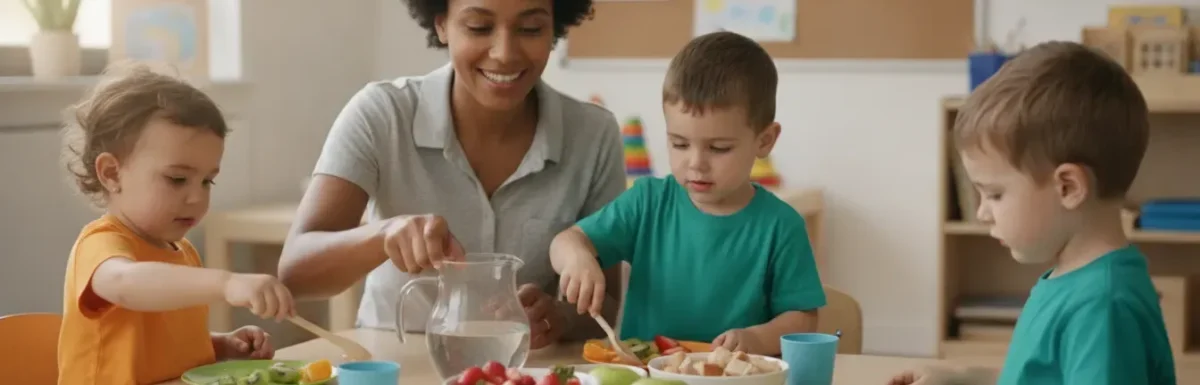
If you are searching for the competency goal for the menu for CDA work, start with the menu you actually use. A weekly menu can show how you plan a healthy learning environment and connect practice to portfolio evidence. Label the connection accurately without turning an illustrative menu into an official Council template.
Talk with National CDA Training about your CDA portfolio plan.
Which CDA Competency Goal Does a Menu Support?
A weekly menu most directly supports Competency Goal I: to establish and maintain a safe, healthy learning environment. Within the current CDA Competency Standards, the Healthy Functional Area includes promoting health, preventing illness, and teaching children about nutrition and wellness. A menu can be evidence of planning, but your current standards book controls the exact requirement.
The best primary connection is Goal I because food service affects children’s health, wellness, routines, and safety. The current CDA Competency Standards and Subject Areas guide identifies Goal I as the safe and healthy learning environment goal. Its Healthy Functional Area describes practices that promote health, prevent illness, and teach children about good nutrition and wellness.
That does not mean every menu proves every part of Goal I. A document alone cannot show how you follow it, communicate with families, or adjust practice when a child’s needs change. Pair it with a short explanation of what you considered and learned.
How Do You Choose the Right Age Group for a CDA Menu?
Choose the age group from your actual CDA credential setting and the children you serve, not from a generic sample. Preschool candidates work with children ages 3 through 5, while an infant-toddler setting serves children from birth through 36 months. The age group changes food texture, independence, supervision, and serving considerations.
Before you create or file the menu, identify three facts:
- Your credential setting: Confirm whether your portfolio is for Preschool, Infant-Toddler, Birth-to-Five, Family Child Care, or Home Visitor work.
- Your assigned or observed group: Note the age range represented by the menu and make sure it matches the children in your classroom or the setting described in the assignment.
- Your program’s food responsibilities: Determine whether your center prepares food, receives meals from a kitchen, uses a posted program menu, or asks teachers to document planned snacks.
The Council for Professional Recognition credentialing FAQs describe the setting distinctions candidates should review when choosing the correct credential. A menu prepared for preschool children should not be presented as an infant-toddler menu simply because both are weekly schedules. Texture, choking-risk procedures, milk guidance, feeding independence, allergies, and supervision may differ significantly.
If your center already publishes a weekly menu, use that program document when permitted. Add a note identifying the program source and the dates it covers. Do not replace a real center menu with a made-up version just because the made-up version looks more polished. If you are completing a class assignment, follow the assignment directions and retain the prompt with your work so a reviewer can see the context.
What Should a Weekly CDA Menu Include?
A useful weekly menu shows the eating occasions covered, the foods planned, the intended age group, and the source or program context. It should make balanced choices easy to see while leaving room for your center’s policies, substitutions, allergies, and cultural food practices. It is a planning record, not medical advice or a universal Council form.
Build the menu around the eating occasions your setting actually provides. Depending on the program, that may include breakfast, lunch, morning snack, afternoon snack, or another scheduled meal. For each occasion, list the food clearly enough that a reviewer can understand the plan. Vague entries such as “healthy snack” do not show what was considered.
Use a simple review checklist:
- Does each day identify the meal or snack occasion?
- Are food groups or components varied across the week?
- Does the plan reflect the children’s ages and developmental abilities?
- Are water access, family preferences, allergies, and program substitutions handled according to policy?
- Can another teacher or family understand what is planned without guessing?
- Is the menu dated and connected to the program, classroom, or assignment?
Balanced does not mean that one meal must contain every possible food group or that a candidate must invent a nutrition formula. It means you can explain the planning choices you made and show that the menu is intended to support children’s health within your setting’s requirements. Include culturally familiar foods when they fit the program and communicate respectfully with families about dietary needs.
| Menu detail | What to record | Why it helps your portfolio explanation |
|---|---|---|
| Eating occasion | Breakfast, lunch, or named snack | Shows the routine and the part of the day being planned |
| Food description | Specific foods and planned substitutions | Lets you discuss variety, access, and child needs |
| Age and setting | Credential setting and classroom age range | Shows that the plan is relevant to the children served |
| Source and date | Center menu, assignment prompt, or teacher plan | Helps distinguish real evidence from an illustrative example |
| Safety and family notes | Program-approved allergy and supervision procedures | Shows that health planning includes more than food selection |
When you need a nutrition benchmark, identify the source before using it. For example, the USDA Food and Nutrition Administration CACFP Snack Meal Pattern says a reimbursable snack selects two of five components and gives different minimum quantities by age. That guidance is useful only when it applies to your program. Do not copy a CACFP table into a CDA portfolio and call it a Council requirement.
How Do Serving Sizes and Nutrition Considerations Fit?
Serving-size considerations belong in the context section of your menu explanation. Use the food-service rules that govern your program, note the children’s age range, and avoid presenting one portion chart as universal. The menu should show thoughtful planning, while your reflection explains how you confirmed safety, nutrition, substitutions, and family communication.
Serving size is not just a number beside each food. The correct amount can depend on age, program rules, the food, and the meal occasion. If your program follows CACFP, keep its current guidance with your planning notes. If state licensing or center policy applies, follow that policy too.
For example, the USDA CACFP snack pattern lists four fluid ounces of milk for ages 1 through 5 and one-half cup of fruit or vegetables for those age ranges, with other quantities for older groups. That is a cited federal meal-pattern example, not a blanket rule for every CDA candidate, childcare program, or family. Current program instructions and the child’s individual care plan take priority.
Do not diagnose allergies, prescribe a diet, or promise that a menu meets an individual child’s medical needs. Instead, explain that you follow the child’s documented care plan and the program’s approved procedures. A professional portfolio shows responsible decision-making. It does not require a candidate to act as a dietitian or medical provider.
Want a structured path from training to portfolio preparation? Review National CDA Training’s individual CDA training options and choose the next step that fits your preparation needs.
How Do You Turn the Menu Into Resource Collection Evidence?
Turn the menu into Resource Collection evidence by keeping the real document, identifying its source and date, naming the children or setting generally, and adding a short connection to Goal I and the Healthy Functional Area. Keep the menu separate from your reflective statement, then cross-reference both with clear labels.
The Council’s Candidate Checklist tells candidates to gather all Resource Collection items and prepare the Professional Portfolio before the Verification Visit. The checklist is a process guide. Your current Competency Standards book and credential-setting directions remain the authority for the exact items and labels you must provide.
Organize the menu so a reviewer can answer five questions quickly:
- What is this? Label it as a weekly menu, menu plan, or program menu, using the wording required by your assignment or current standards.
- Where did it come from? Record whether it came from your center, your own approved planning, or a class assignment.
- Who is it for? State the credential setting and broad age range. Do not include children’s names or confidential health details.
- What does it show? Briefly identify planning for health, nutrition, routines, safety, or communication with families.
- How does it connect? Name Goal I and explain the specific decision the menu helps demonstrate.
A simple cover note can make the evidence easier to understand: “This dated menu is from my preschool program. It supports Competency Goal I because it documents planning for healthy meals and snacks for my assigned group. I followed the program’s food-service and allergy procedures.” Adapt it to your setting. This is illustrative, not an official Council statement or required template.
Keep supporting material limited to what helps explain the menu, such as the planning prompt, an approved substitution note, or a privacy-safe family communication example. Do not overload the section with unrelated recipes or private medical records.
How Do You Reflect on a Menu Without Inventing Evidence?
A menu reflection should describe your actual planning decision, the reason it mattered for the children you serve, what happened when the plan was used, and what you would adjust next time. Use prompts to organize your thinking, but replace every placeholder with your own observation. Never submit an invented classroom result as personal evidence.
Use a four-part reflection structure:
- Decision: What did you plan, and what health or wellness consideration shaped the choice?
- Reason: How did the children’s ages, abilities, culture, family information, or program policy influence the plan?
- Practice: What did you do during the meal or snack routine? Describe supervision, communication, independence, or a safe classroom procedure that you actually used.
- Next step: What did you learn, and what will you continue, revise, or verify?
For instance, do not write that children enjoyed a food or tried a new vegetable unless you observed it. Use a prompt such as “During the planned snack, I noticed…” and complete it from your notes. If the menu was only a class exercise, say so and reflect on planning rather than pretending to have observed children.
Connect the reflection to the evidence without overstating it. A menu can demonstrate intentional planning. Your observation and explanation show how the plan operated in practice. Together, those materials can help you explain Goal I more clearly than a menu with no context.
Before filing, replace broad claims such as “children always” with a specific observation, remove unsupported nutrition or compliance claims, omit private information, and check the current Council wording.
What Menu Mistakes Can Weaken a CDA Portfolio?
The most common menu problems are using the wrong age group, omitting the source or date, confusing a program rule with a Council requirement, providing a generic “healthy” list with no explanation, and inventing classroom outcomes. A clean, dated document with a truthful Goal I connection is stronger than a polished but unsupported sample.
- Using a random online sample: A sample may not match your setting or assignment. Use it for ideas, never as evidence of your practice.
- Calling a menu an official Council form: The current Competency Standards book and candidate directions control. A National CDA Training example or USDA chart is not automatically a Council requirement.
- Ignoring the age range: Infant-toddler and preschool planning can involve different textures, supervision, independence, and portion guidance.
- Listing food without the “why”: Explain what you considered and how the plan supports a safe, healthy learning environment.
- Including confidential information: Remove names and private health details. Refer to approved procedures in general terms.
- Overpromising nutrition compliance: Name the standard you checked and avoid universal claims when the rule is program-specific.
Before filing, compare the item with the CDA Resource Collection checklist and current official materials. The checklist can organize your collection, but it does not replace your credential-setting directions.
Get practical CDA portfolio guidance from National CDA Training.
What Are Common Questions About the CDA Menu Competency Goal?
The short answer is that a menu most directly connects to Goal I and the Healthy Functional Area, but the exact portfolio item depends on the candidate’s credential setting and current instructions. Use a real, dated document, cite the applicable program guidance, and explain the connection in your own words.
Is the menu Competency Goal I or Goal II?
Start with Goal I because the menu concerns health, nutrition, wellness, and a safe learning environment. It may also create secondary opportunities for physical, social, or communication development during meals, but those connections should come from your actual practice and should not replace the primary health connection.
Does every CDA candidate have to submit the same menu?
No single generic article or sample should be treated as the final authority for every credential setting. Confirm the item and wording in your current CDA Competency Standards book, credential-setting directions, and program assignment. Keep the source of your menu clear.
Can I use my center’s existing weekly menu?
If your center permits it and the document fits your assignment, an authentic program menu is often more useful than an invented sample. Add context about the date, age group, source, and your role. Remove confidential information and explain which parts reflect your planning or professional practice.
Should a CDA menu include exact serving sizes?
Include serving-size information only when it is required or relevant to the governing program standard. Identify the source, age group, and meal occasion. Do not present CACFP quantities, state rules, or a center policy as universal Council requirements.
Can I use a sample reflection from the internet?
Use samples as a way to understand structure, not as your own evidence. Your final reflection should be based on your actual menu, decisions, observations, and next steps. If a menu was only a classroom exercise, reflect honestly on the planning process and say that it was not served.
What Is the Next Step for Your CDA Menu Evidence?
Next, confirm your credential setting, retrieve the current official instructions, locate the real menu or assignment prompt, and add a dated Goal I connection. Then review the item for age relevance, balanced planning, serving-size source, privacy, and truthful reflection before placing it in the correct portfolio section.
A strong menu entry does not need to look like a perfect nutrition worksheet. It needs to be relevant, understandable, accurately labeled, and grounded in what you actually do. Use the menu to explain your professional choices, then use your reflection to show what you learned from those choices.
For a broader portfolio plan, review National CDA Training’s CDA portfolio requirements checklist and its overview of the six CDA Competency Goals. Return to the current materials from the Council for Professional Recognition whenever requirements or portfolio tools change. That combination of practical organization, official-source checking, and honest reflection will help your menu support your CDA portfolio without claiming more than the evidence can show.