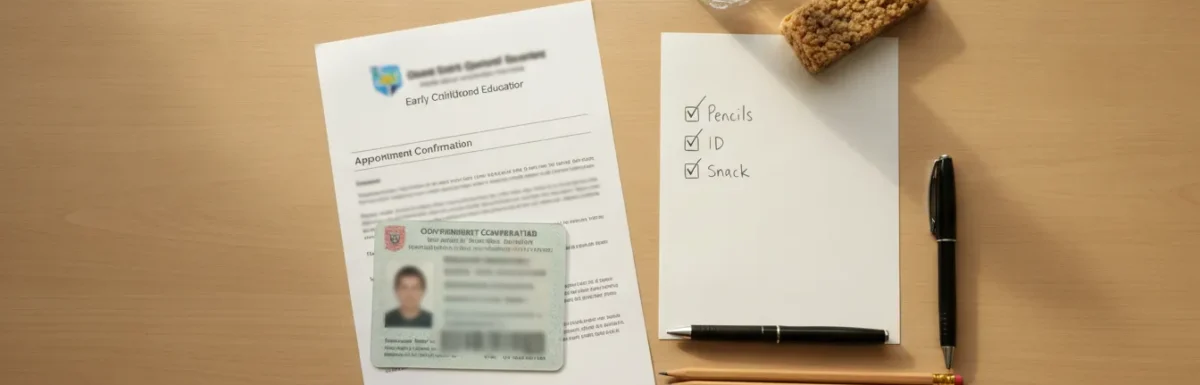
CDA Exam Day Checklist: What to Bring and How to Prepare
Your CDA exam appointment is the final opportunity to demonstrate the professional knowledge you have developed through training and classroom experience. A clear CDA exam day checklist protects that work by helping you arrive with the correct identification, understand the computer-based test process, and focus on the questions rather than preventable logistics.
Prepare for your CDA credential with flexible individual training.
The essential checklist: confirm that your original, valid government-issued photo ID matches your registration name; verify the test center address and appointment time; arrive at least 15 minutes early; expect to store personal belongings; and use the evening before the exam for light review, route planning, and rest. Official Council for Professional Recognition and Pearson VUE requirements are identified below. Recommendations about clothing, meals, pacing, and managing test anxiety are general preparation advice, not testing-center requirements.
CDA exam day checklist: what to bring
The most important item is acceptable identification. Pearson VUE’s published ID policy states that a primary ID must be an original, valid government-issued document with your name, a recent recognizable photo, and a signature. Your first and last name must match the name used for registration. Review the current Pearson VUE ID policy before your appointment because the official policy, not general advice, determines whether your identification is accepted.
Bring your appointment confirmation or Ready to Schedule information as a helpful reference. It can make it easier to confirm your appointment details and candidate information, but it does not replace acceptable identification. If the confirmation or your test-center instructions identify any additional requirement, follow those official instructions.
- Required: An acceptable original, valid government-issued primary ID that matches your registration name.
- Helpful: Your appointment confirmation and Candidate ID information.
- Confirm before leaving: Appointment time, test-center address, route, parking plan, and travel time.
- Plan to store: Phone, watch, bag, notes, and other personal belongings, according to center instructions.
- Keep outside the testing room: Water and a snack for before or after the appointment, if useful.
If your name has changed, your ID is expired, or you are unsure whether a document meets the rules, resolve the question before exam day. Pearson VUE’s policy describes limited circumstances involving expired identification and official renewal documentation. Do not rely on a photocopy, a digital image, or an assumption that staff can make an exception.
Official requirements versus general preparation advice
A reliable checklist separates rules from recommendations. This distinction matters because official requirements can affect whether you are admitted to the certification exam, while preparation advice is intended only to support comfort and concentration.
| Topic | Official rule or general advice? | What to do |
|---|---|---|
| Acceptable ID | Official Pearson VUE rule | Bring an original, valid government-issued primary ID with the required name, photo, and signature. |
| Arrival time | Official Council guidance | Arrive at least 15 minutes before the scheduled appointment. |
| Personal belongings | Testing-center security procedure | Expect to store personal items and follow staff instructions. |
| Layers and comfortable clothing | General preparation advice | Choose professional, comfortable clothing appropriate for sitting through the exam. |
| Breakfast, water, and snack | General preparation advice | Eat beforehand if appropriate and keep food and drinks outside the testing room. |
| Breathing and pacing strategy | General preparation advice | Use familiar techniques that support focus and help manage test anxiety. |
The Council’s CDA Exam preparation guide states that candidates should arrive at least 15 minutes before the appointment. It also explains the exam’s timing and format. Pearson VUE controls ID and test-center procedures. When either official source differs from general preparation advice, follow the official source and the instructions provided for your specific appointment.

What to confirm before leaving home
Check your identification and registration name
Compare the name on your primary ID with the name in your exam registration. Look at every part of the name rather than assuming the records match. Confirm that the document is original, valid, government issued, and includes the required photo and signature. Place it in the wallet or bag you will use, then check again before leaving.
If you do not have a primary ID issued in the country where you are testing, review Pearson VUE’s policy for the applicable passport requirements. If there is any uncertainty, contact exam support in advance. Addressing an ID issue early is more effective than trying to resolve it at the check-in desk.
Verify the appointment and route
Open your confirmation email and verify the date, local time, address, and any location-specific instructions. Map the route and account for traffic, parking, public transportation, and the time needed to find the testing-center entrance. Set a departure time that supports arriving at least 15 minutes early without creating an unnecessarily long wait.
Prepare only what you need
Testing centers use security procedures to protect exam integrity. Expect to store personal belongings such as your phone, watch, bag, outerwear, and notes. Bring as little as practical and follow staff directions. Do not plan to use study materials, food, or drinks inside the testing room unless your official appointment instructions expressly authorize an accommodation.
Use this concise final check
- Confirm that your ID meets Pearson VUE rules and matches your registration name.
- Confirm the appointment date, time, address, and center instructions.
- Plan to arrive at least 15 minutes early.
- Choose a route and backup transportation plan.
- Place your ID and confirmation information where they are easy to access.
- Leave prohibited or unnecessary belongings at home when possible.
- Set an alarm, plan breakfast, and protect your sleep schedule.
What happens at the CDA exam center?
Knowing the sequence can reduce uncertainty. At check-in, staff will verify your identification and direct you through the center’s security procedures. You may be asked to store personal belongings in a locker or another designated area. Follow the instructions given by staff, even if a detail differs from what another candidate experienced at a different location.
After check-in, you will be assigned a workstation for the computer-based test. According to the Council’s prep guide, the exam includes 65 questions and allows 1 hour and 45 minutes for testing. Before the exam clock begins, candidates receive 15 minutes to review instructions, agree to the rules, and complete three practice questions using the mouse. The computer also provides time notifications when 30 minutes and 10 minutes remain.
Use the introductory period to become familiar with the screen, controls, and testing environment. This is not a content review period. If you have a procedural question, raise it with staff before beginning rather than making assumptions once the timed exam is underway.
Build confidence with a CDA practice test before exam day.
How to manage your time during the certification exam
With 65 questions in 1 hour and 45 minutes, you have an average of slightly more than 90 seconds per question. Some questions will take less time and others will require careful consideration. The goal is not to force an identical pace on every item. Instead, maintain steady progress and protect enough time to answer every question.
Start with a practical pacing plan
Before test day, become familiar with answering questions within a limited period. A structured CDA exam study schedule can help you practice consistently without relying on last-minute cramming. During the exam, use the computer’s time notices as checkpoints. If one question is consuming too much time, choose the strongest answer you can support and continue.
Read for the decision being tested
Read each question and all answer choices carefully. Focus on the specific situation presented and the response that best reflects sound early childhood practice. Avoid adding facts that are not in the question. Your professional experience is valuable, but the exam asks you to select the best response for the stated scenario.
Review without second-guessing everything
If the testing interface permits review, use remaining time for questions you found difficult and to confirm that every question has an answer. Change an answer when you identify a clear reason, not simply because you feel nervous. A deliberate review is useful; repeatedly revisiting every decision can increase test anxiety without improving accuracy.
How your professional experience supports exam preparation
The CDA exam is connected to the work early childhood educators perform every day. As you prepare, organize your thinking around safe, responsive, developmentally appropriate practice rather than trying to memorize isolated phrases. Consider how your decisions support children, families, colleagues, and a well-managed learning environment. This approach allows you to connect study material with professional judgment while still responding only to the facts presented in each question.
Use scenarios to practice decision-making
When reviewing a scenario, identify the immediate issue, the people affected, and the response that best supports children while maintaining professional responsibilities. Then compare the options carefully. This process helps you practice selecting the best available response, not simply one that could be acceptable in a different situation.
After a practice session, review why each correct response is stronger than the alternatives. Record patterns in the questions you miss and return to the relevant training material. Focused review is more useful than repeatedly completing questions without analyzing the results.
Protect your preparation in the final days
During the final days, prioritize consistency. Continue your planned review, but avoid replacing a proven study schedule with an intense last-minute effort. Confirm the logistical details early so they do not compete with content review. If you need clarification about training material, ask while there is still time to use the answer.
Confidence should come from evidence: completed training, thoughtful practice, and a clear exam-day plan. You do not need to feel completely free of nerves to perform effectively. You need a process that helps you direct your attention to the next decision.
Last-minute preparation for a calm exam day
Effective final preparation is restrained and purposeful. By the night before the exam, your priority is to protect the knowledge you have already developed. A short review, a prepared route, acceptable ID, and adequate rest usually support performance better than an extended late-night study session.
The evening before
Review a limited set of notes or a familiar practice activity, then stop at a planned time. Confirm the appointment details and set out your ID. Choose clothing suitable for sitting comfortably in a professional testing environment. If room temperature is a concern, consider layers, while recognizing that the center may require outerwear to be stored.
Pack lightly. Place permitted essentials together and leave unnecessary items at home. Prepare breakfast or another appropriate meal plan. These steps are general recommendations, not Council or Pearson VUE requirements, but they reduce the number of decisions you must make in the morning.
The morning of the exam
Follow your normal routine as closely as possible. Eat and hydrate in a way that works for you, remembering that food and drinks generally will not be allowed at your workstation. Leave with enough time to handle routine delays. Before you depart, complete one final ID and appointment check.
Managing test anxiety professionally
Feeling some test anxiety before an important professional milestone is common. Treat it as a signal to return to your plan. Slow your breathing, place both feet on the floor, and focus on the next task: check in, read the instructions, then answer one question at a time. Avoid introducing a new study technique or unfamiliar routine on exam day.
If anxiety has significantly affected prior testing experiences, seek appropriate support well before the appointment and review official procedures for any needed accommodation. Do not wait until check-in to request a change that may require advance approval.

After the exam
When you finish, follow the computer prompts and the center staff’s instructions. The Council’s prep guide explains that candidates complete a brief survey and receive documentation confirming completion of the exam. That confirmation is not the final credentialing decision. Preserve any paperwork the center provides and continue following the official CDA credentialing process.
Avoid trying to reconstruct every answer immediately after the test. Note any official next steps and deadlines, retrieve your belongings, and give yourself time to transition out of the testing environment. If you have questions about your National CDA Training coursework or preparation, the support team is available at (269) 444-6128.
Common exam-day mistakes to avoid
The most consequential mistakes are often logistical. Do not wait until the morning of the appointment to check whether your ID is valid or whether the registration name matches. Do not assume a photo of an ID will be accepted. Do not plan an arrival that leaves no margin for traffic, parking, or check-in. These issues are preventable when you review the official requirements in advance.
Also avoid bringing a large collection of personal items that must be stored, attempting an extensive review immediately before check-in, or allowing one difficult question to disrupt your pacing. None of these points changes the official testing rules; they are practical ways to reduce distraction.
Finally, rely on current official sources for requirements. Advice from colleagues can be useful for understanding the general experience, but procedures may vary by location or change over time. Your appointment instructions, the Council’s preparation guide, Pearson VUE’s ID policy, and test-center staff are the authoritative sources for exam-day procedures.
Frequently asked questions
What ID should I bring to the CDA exam?
Bring an original, valid, government-issued primary ID with your name, recent photo, and signature. The name must match your exam registration. Review Pearson VUE’s current policy before test day for complete details and any situation-specific rules.
How early should I arrive for the CDA exam?
The Council for Professional Recognition prep guide directs candidates to arrive at least 15 minutes before the scheduled appointment. Plan additional travel time for traffic, parking, and finding the entrance.
Can I bring notes, a phone, food, or water into the testing room?
Personal items are generally not allowed in the testing room and must be stored as the test center directs. Follow your confirmation instructions and center staff. Keeping water or a snack outside the room is general preparation advice, not an official requirement.
How long is the CDA exam?
The CDA exam has 65 questions and allows 1 hour and 45 minutes for testing. The Council’s guide also describes a separate 15-minute period for instructions and practice questions before the timed exam.
What should I do if my ID name does not match my registration?
Contact the appropriate exam support channel before test day. Do not assume the testing center can admit you when the names do not match. Resolve the discrepancy in advance and follow Pearson VUE’s current ID policy.
Take the next step with confidence
A successful exam day begins with a precise plan: acceptable identification, a verified appointment, an early arrival, and a clear understanding of the computer-based test. Separate official Council and Pearson VUE rules from general preparation advice, then use both appropriately. Your professional training and experience are the foundation; this checklist helps ensure logistics do not interfere with your opportunity to demonstrate them.
Explore National CDA Training’s individual CDA courses and prepare for your next step.