
Family child care CDA requirements include being at least 18, holding a high school diploma or GED, completing 120 training hours and 480 recent work hours, preparing a Professional Portfolio, and completing the CDA exam and Verification Visit in a home-based setting.
Your family child care home can become the setting where you earn a national CDA credential. The process becomes manageable when you separate preparation from the final assessment.
The Council for Professional Recognition administers the credential nationally and assesses candidates through evidence of knowledge and practical skills. Because home child care rules vary by location, candidates should also check applicable state and local licensing standards before starting the application.
The central question is simple: What are the Family Child Care CDA requirements? We will break each requirement into a workable order from the start, so you can plan training, gather records, and apply with fewer surprises.
What are the Family Child Care CDA requirements?
The Family Child Care CDA is for an educator who provides care in a home-based setting. It fits providers who work with young children in the daily flow of a family child care home. This setting matches the place where they show their skills.
This credential is not simply another name for every CDA. The Council offers separate Family Child Care, Preschool, Infant-Toddler, and Home Visitor settings. Its current CDA guidance says candidates must choose a setting that matches their work.
The home-based setting
Family Child Care fits educators whose regular work happens in their own home. Their work can include learning activities, safe routines, family communication, and care that responds to each child’s needs. These duties shape the evidence they prepare for assessment.
Preschool and Infant-Toddler are different credential settings. A Preschool candidate shows skills related to preschool care. An Infant-Toddler candidate focuses on care for infants and toddlers. Family Child Care candidates show how they provide early care within a home program.
| Point of comparison | Family Child Care | Preschool | Infant-Toddler |
|---|---|---|---|
| Care setting | Family child care home | Preschool program | Infant-toddler program |
| Main focus | Home-based early care | Preschool care | Infant and toddler care |
| Best fit | Home-based providers | Preschool educators | Infant and toddler educators |
| Assessment evidence | Comes from home-based practice | Comes from preschool practice | Comes from infant-toddler practice |
The work setting matters because it shapes the candidate’s experience, portfolio evidence, and Verification Visit. Choose based on where you can show your skills in practice. Do not choose only by the setting name that sounds most familiar.
Core eligibility and preparation
Family Child Care candidates follow the main CDA pathway while preparing in their chosen setting. They must be at least 18 and hold a high school diploma or GED. Current Council guidance also allows enrollment in a qualifying vocational early childhood education program.
The preparation path includes 120 clock hours of early childhood education across eight CDA subject areas. Candidates also need 480 hours of recent professional work with young children. A structured 120-hour CDA training course can help working educators cover the required subject areas.
Candidates also prepare a professional portfolio, complete an assessment, and take part in a Verification Visit. These steps let them show how they use sound early care practices in a real home-based program.
Choosing the right setting
Start with the place where you currently provide care and the children you serve. If you work mainly in your own home, Family Child Care is likely the closest match. Preschool and Infant-Toddler educators should compare those paths instead.
Check local rules before applying because licensing standards differ by location. The CDC’s state licensing guidance explains that child care licensing is set by states and territories. Your CDA setting and local license are related, but they are not the same requirement.
Confirm your eligibility and work experience
Before you begin an application, check that your background matches the Family Child Care setting. This early review can help you choose the right credential setting and collect useful records as you work.
Age and education prerequisites
CDA candidates must be at least 18 when they apply. They also need a high school diploma or GED. Current enrollment in a vocational early childhood education program can meet the education prerequisite instead.
These prerequisites are separate from training and work experience. If you meet them, review the full process for earning your CDA credential. It can help you see how your training, portfolio, exam, and visit fit together.
The 480-hour experience requirement
You must document 480 hours of professional work with young children during the three years before applying. For a Family Child Care CDA, that work should take place in a home-based child care setting.
Your hours may build over time rather than come from one long stretch of work. For example, a provider might track regular care hours each week until reaching the total. Keep clear records that show dates, hours, setting, and the children served.
The experience requirement and the 120-hour CDA training requirement serve different purposes. Your work hours show hands-on practice, while training builds knowledge across the eight CDA subject areas. You need to complete both parts.
Your setting and observation visit
Choose the setting that matches your daily work. Family Child Care is meant for educators who provide care in a home. Preschool, Infant/Toddler, and Home Visitor are separate CDA settings with different work contexts.
A CDA Professional Development Specialist will observe you in your work setting during the Verification Visit. Plan for a home-based setting where the specialist can see your normal care practices with children.
Also check the rules where you provide care. State child care licensing requirements vary and may affect home-based providers. Confirm local licensing duties separately from the national CDA process.
Complete the required 120 hours of CDA training
Completing 120 clock hours of professional early childhood education is a core part of the family child care CDA requirements. The training must cover all eight CDA subject areas, not just the topics you use most often. A complete program should show how each topic applies in a home-based child care setting.
What the eight subject areas cover
The eight areas build the knowledge needed to care for children, work with families, and manage a professional program. Together, they connect daily care with safety, learning, observation, relationships, program operations, and continued growth.
- Planning a safe and healthy learning environment
- Supporting children’s physical and intellectual development
- Supporting children’s social and emotional development
- Building productive relationships with families
- Managing an effective program operation
- Maintaining a commitment to professionalism
- Observing and recording children’s behavior
- Understanding principles of child development and learning
These areas matter because family child care providers fill many roles during one day. You may plan an activity, prepare food, guide behavior, speak with a parent, and update records. The CDC describes professional development as essential for safe, healthy, and developmentally appropriate child care environments.
Choosing training for family child care
Look for training that covers every subject area and clearly records completed clock hours. It should also match the Family Child Care setting, where educators care for children in a home-based environment. Practical lessons can help you connect course ideas to mixed-age groups, family partnerships, routines, and program management.
National CDA Training’s 120-hour CDA training offers an online path for working educators. Its scenario-based lessons focus on using knowledge in real child care situations instead of memorizing terms alone. Before enrolling, confirm that the provider supplies clear proof of your completed training and subject areas.
Course format also affects whether your plan is easy to maintain. Self-paced lessons may fit around care hours, while set deadlines can help some learners stay on track. Choose a format you can follow each week without putting daily care duties aside.
How to organize your 120 hours
Start by making a simple tracker with one row for each subject area. Record the course name, date, clock hours, and completion document as you finish each part. This habit makes gaps easy to spot and keeps your records ready for the application process.
- Set a weekly study block that fits your child care schedule.
- Work through one subject area at a time when possible.
- Save each certificate in one digital folder and one backup location.
- Review your tracker each month and plan the next course.
Your CDA training does not replace state child care rules. Since child care licensing rules vary by state, check your local agency’s training and licensing requirements too. Keeping CDA and state records together can make both sets of duties easier to manage.
How do you prepare the CDA Professional Portfolio?
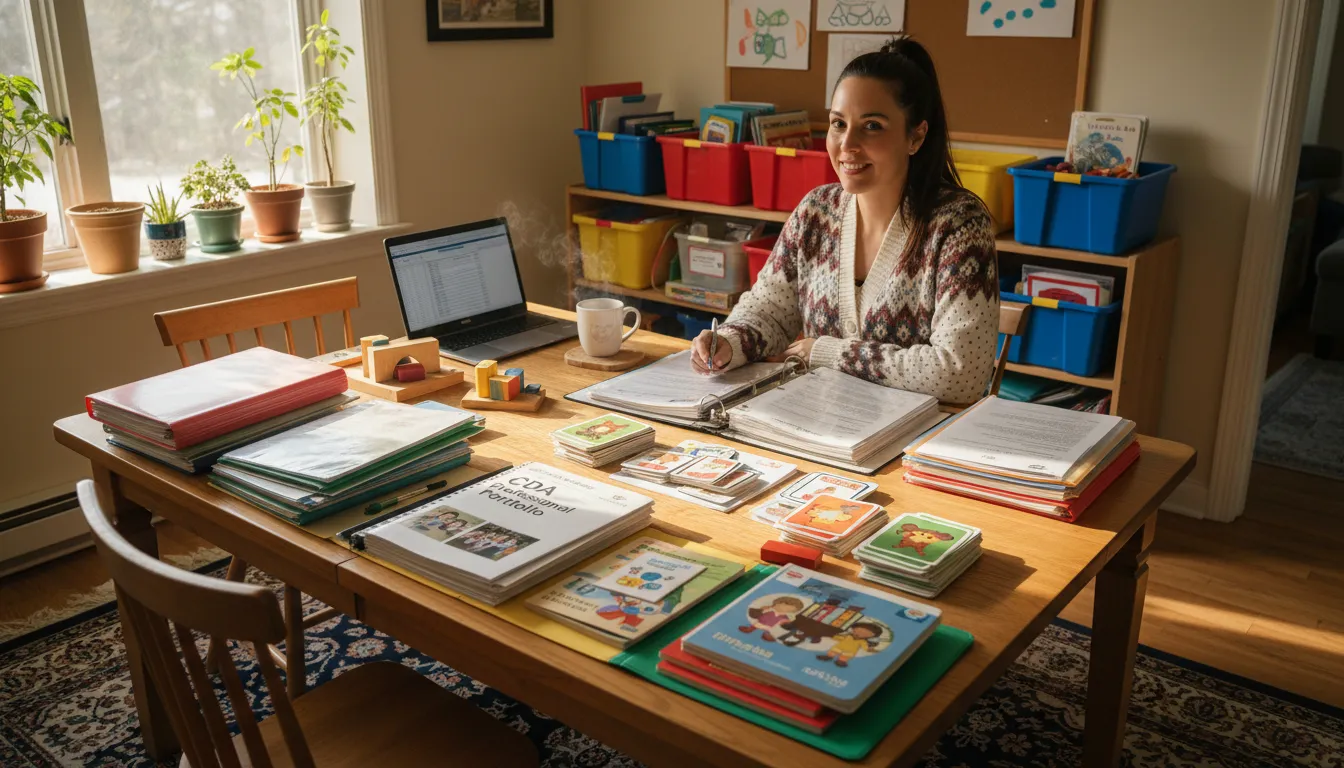
Build your Professional Portfolio as you complete your training and work experience, not during the final week. The portfolio collects resources and evidence that show how you work with children and families. It also helps you reflect on daily choices before your assessment.
A simple collection schedule
Start with the current portfolio instructions for your Family Child Care setting. Create a checklist for every required item, then add a due date beside each one. This approach keeps the portfolio connected to your progress toward earning your CDA credential.
Set aside a short block of time each week to collect, label, and review materials. Keep paper items in a binder with dividers, or use matching folders for digital copies. Name each section clearly so an assessor can find the right evidence without searching.
- Make one master checklist and mark items only after reviewing them.
- Label each resource with its required portfolio section.
- Keep backup copies of items that may be hard to replace.
- Review the full portfolio well before the assessment process begins.
Include a folder for state or local rules that affect your home-based program. Child care licensing rules can vary by state. The CDC overview of state child care licensing explains where providers can find their state agency. Keeping these materials together makes later updates easier.
Family questionnaire file
Give families enough time to complete each required questionnaire. Explain its purpose in plain language, share the due date, and offer a clear way to return it. Track which questionnaires were shared and returned, while protecting each family’s privacy.
Review the responses for themes that can guide your work. Families may point out strengths, needs, or communication gaps that are easy to miss during a busy day. Use those themes when reflecting on your practice. Follow the current handbook’s rules for handling completed forms.
Competency statements and resources
Draft each competency statement from real examples in your Family Child Care program. Describe what you do, why you do it, and how the practice supports children. Connect each statement to a specific routine, activity, policy, or family interaction.
Collect resources while the related topic is fresh from your 120-hour CDA training. Choose useful items that you could apply in your program, rather than filling sections with generic handouts. Check that every item is current, readable, and placed in the correct section.
Finish with a page-by-page review against the latest official instructions. Look for blank fields, missing labels, weak examples, and items placed in the wrong section. A trusted colleague can also test whether the portfolio is easy to follow. Use National CDA Training’s CDA resources for additional guidance as you organize your materials.
Follow the Family Child Care CDA application steps
The Family Child Care CDA process moves from preparation to assessment in a set order. Before applying, check that your records show you meet the family child care CDA requirements. A simple checklist can prevent delays once the formal assessment begins.
Preparation before the application
First, confirm that Family Child Care is the right CDA setting for your work. It is meant for educators who provide care in a home-based setting. Also review your state’s rules, since child care licensing requirements vary by state.
Next, gather proof of your education, training, and work experience. Complete the required 120-hour CDA training across all eight subject areas. Make sure your records also show 480 hours of recent work with young children.
Build your Professional Portfolio before you apply. Include the required resources and clear proof of your work with children and families. Review every item for missing dates, unclear labels, or gaps that could slow the assessment.
The application and assessment sequence
Once your preparation is complete, follow each step in order. Keep copies of every form and note each date. These records make it easier to track your progress and respond if the Council asks for more information.
- Complete a final readiness check. Confirm your age and education records, training certificate, work hours, and Professional Portfolio are ready.
- Submit your CDA application. Select the Family Child Care setting and provide the records requested through the Council’s application process.
- Find a Professional Development Specialist. Choose an eligible specialist who can complete the Verification Visit in your family child care setting.
- Prepare for the Verification Visit. Organize your portfolio, review your practices, and make sure the specialist can observe your usual work with children.
- Complete the Verification Visit. The specialist observes your work setting and reviews evidence of your skills, portfolio, and self-assessment.
- Take the CDA Exam. Use your training and hands-on experience to prepare for questions about key early childhood education skills.
- Wait for the Council’s decision. The Council reviews the assessment results and decides whether to award the Family Child Care CDA credential.
Readiness checks at each stage
Do not schedule an assessment step until the work before it is complete. For example, your portfolio should be finished before the Verification Visit. Your setting should also allow the specialist to observe normal family child care routines.
Before the exam, review all eight CDA subject areas and connect each topic to your daily practice. Scenario-based study can help you apply ideas instead of recalling terms alone. For more context, review the full guide to earning your CDA credential.
After both assessment parts, watch for messages from the Council and reply to requests promptly. Keep your contact details current while the decision is pending. If you receive the credential, save the award records with your other professional documents.
What happens during the Verification Visit and exam?
The Verification Visit and CDA exam are the final assessment parts of your credential process. Together, they check how you apply early childhood knowledge in daily family child care work. They also give you a chance to explain the choices behind your practice.
The ROR model during your visit
The visit follows the ROR model: Review, Observe, and Reflect. A CDA Professional Development Specialist first reviews your Professional Portfolio and related materials. The specialist then observes you working with children in your family child care setting.
During the reflective dialogue, expect to discuss your strengths, goals, and reasons for making certain teaching choices. Use clear examples from your own work. Your portfolio should help you connect each answer to real routines, learning activities, and interactions with children.
This process is not only about showing polished activities. It looks at the thought behind your decisions and how your practice supports children. That focus matters because the CDC links professional development with safe, healthy, and developmentally appropriate early learning settings.
What the CDA exam checks
The CDA exam is a standardized test of key early childhood education skills and knowledge. The full assessment also considers your portfolio and self-assessment. Review the main CDA subject areas, but focus on how each idea applies in a home-based setting.
For example, think through how you would respond to common family child care situations. These may involve mixed-age groups, family communication, safe routines, or child guidance. Scenario practice can help you choose an answer based on sound practice instead of memorized wording.
The exam is one part of earning your CDA credential, so prepare for it alongside the visit. Keep your study notes tied to the same skills shown in your portfolio and daily care.
Practical preparation for both assessments
Before the visit, organize your portfolio so you can find each item without delay. Check your learning space, planned activities, and regular safety routines. Continue using routines that children know, rather than planning an unusual performance for the observer.
- Practice explaining why you chose an activity, routine, or guidance method.
- Review examples that show how you meet the needs of different ages.
- Study in short sessions and answer practice questions without rushing.
- Confirm your visit and exam details before each scheduled assessment.
Use your normal work as the base for preparation. Strong answers are easier when you can connect them to children, families, and choices from your own setting. That approach keeps the visit, reflective dialogue, and exam focused on the same professional skills.
Plan your timeline and avoid common application delays
Start by working backward from the date when you hope to submit your application. Build in extra time for records, portfolio items, and schedule changes. Family child care educators often balance training with long care days, so a steady weekly plan is easier to maintain.
Your readiness checklist
Before choosing an application date, list what is complete and what still needs work. Your plan should cover the full process, not just training. This overview of earning your CDA credential can help you see how the main pieces fit together.
- Confirm that you meet the age and education eligibility rules.
- Choose Family Child Care as the setting that matches your work.
- Track your completed training across all required subject areas.
- Organize proof of work experience before you apply.
- Finish and review every part of your professional portfolio.
- Prepare for the exam and the Verification Visit.
Check local rules early as well. State child care licensing requirements can vary, including rules for home-based providers. Knowing those rules helps you plan for documents or steps beyond the national credential process.
Sequencing mistakes that cause delays
A common mistake is treating each requirement as a separate project. Instead, connect the work whenever possible. Save useful portfolio material while completing training, and track experience hours as you earn them. This approach keeps records from piling up near the application date.
- Do not submit before checking that every document is complete and easy to read.
- Do not wait until training ends to start the portfolio.
- Do not assume your state rules match another provider’s rules.
- Do not schedule assessment steps before confirming your setting and readiness.
- Do not rely on old application instructions, fee amounts, or policy details.
Leave room for reviews and corrections. Ask a trusted colleague to check your portfolio against the current instructions. Then verify the latest application fees, payment rules, and policies directly with the Council for Professional Recognition before submitting.
A timeline that fits working educators
Use short weekly goals instead of one distant deadline. For example, set separate targets for training, experience records, portfolio sections, and assessment preparation. Review progress each week, then adjust the next target when work or family needs change.
Keep one folder for certificates, forms, and notes. Name files clearly and back them up in a safe place. A simple tracking sheet can show what is done, who must respond, and which item needs follow-up. This routine makes missing pieces easier to spot before they delay your application.
Frequently Asked Questions
Does a Family Child Care CDA replace a state child care license?
No. A Family Child Care CDA is a national professional credential, while child care licenses are governed by state or local rules. The CDC explains that child care licensing requirements vary by state. Check with your licensing agency to learn which rules, approvals, training, and records apply to your home-based program.
Can Family Child Care CDA training be completed online?
Yes, online training can provide a flexible way to complete the required early childhood education coursework. Choose a program that documents 120 clock hours and covers all eight CDA subject areas. Keep every completion certificate and training record for your application. The online coursework does not replace the required professional work experience, portfolio, exam, or Verification Visit.
When must a Family Child Care CDA credential be renewed?
A Family Child Care CDA must be renewed every three years to remain valid. Renewal includes completing 45 hours of early childhood education professional development. Review the current Council renewal rules before your deadline because documentation and policy details may change. National CDA Training provides more information about CDA renewal training and the required professional development hours.
Can I choose the Family Child Care CDA if I work in a child care center?
The Family Child Care CDA is intended for educators who provide care in a home-based setting. Candidates working in a child care center should compare the Preschool, Infant-Toddler, and Birth to Five settings before applying. Choose the setting that matches your daily work and where your Verification Visit can occur. The Council for Professional Recognition provides current guidance on CDA settings.
Ready to Start Your Family Child Care CDA?
Delaying your training can push back your application and leave less time to organize your portfolio, work experience, and other required materials with confidence. Starting now gives you a clear path to complete each step at a steady pace while balancing work and family responsibilities from the beginning. With your training underway, you can focus on building the knowledge and documentation needed to move toward your Family Child Care CDA with greater confidence.
Start your online CDA training today
Contact the National CDA Training team if you need help choosing your next step.